
Kathmandu, November 19
Whenever cooking gas shortages intensify in Nepal, debates over cylinder size, weight and colour tend to resurface instead of long-term solutions to the country’s supply problems.
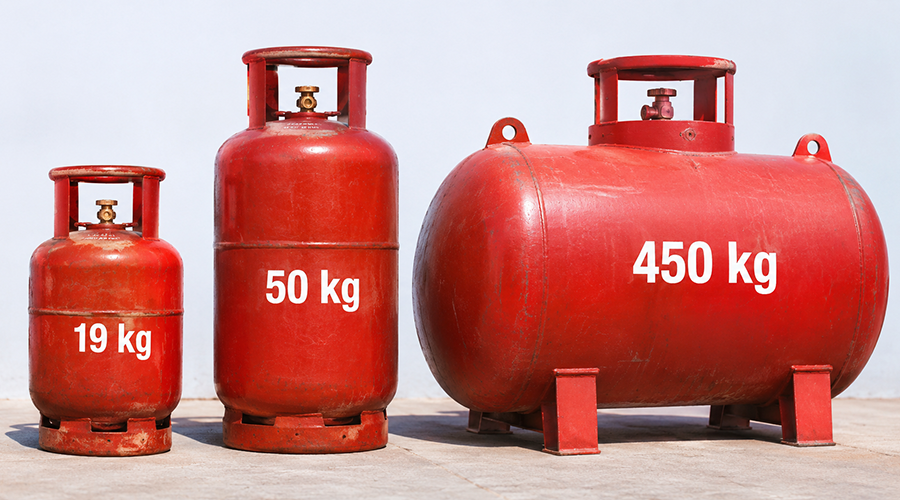
From introducing half-filled 7.1 kg cylinders to proposals for 19 kg, 50 kg and 450 kg cylinders for commercial and industrial use, authorities have repeatedly explored changing how LPG is distributed.
Even as gas supply remains relatively smooth in the Tarai, consumers in Kathmandu Valley continue to struggle to obtain LPG. Amid the ongoing difficulties, Nepal Oil Corporation (NOC) is preparing to introduce 19 kg, 50 kg and 450 kg cylinders for commercial and industrial consumers, alongside the existing 14.2 kg household cylinders.
However, industry representatives argue that changing cylinder sizes alone will not resolve Nepal’s recurring gas shortages. They say the country’s dependence on imports, inadequate storage infrastructure, inconsistent policies and weak regulation remain the fundamental problems, while changes in cylinder size could create further market confusion and increase the risk of black marketing.
Supply and storage, not cylinder weight, at the root of shortages
Nepal produces no LPG and depends entirely on Indian refineries and bullet tankers to meet domestic demand. With no government-operated LPG storage facility in the country, even a slight reduction in loading from India or disruption along transport routes can trigger shortages.
The current difficulties in Kathmandu Valley are also linked to import supply rather than cylinder size, according to Diwan Chand, president of the Nepal LPG Industry Association.
Chand said loading from India’s Barauni refinery has remained regular, but Paradip refinery has been supplying less gas than its allocated quota, preventing supply from fully normalising in the Valley.
“Even if you introduce cylinders of any size, the problem remains the same if you cannot bring in the gas,” Chand said, arguing that changing cylinder weight cannot address the underlying supply constraints.
NOC, however, argues that commercial consumers have been using household-priced LPG, resulting in substantial financial losses for the government and the corporation. It says introducing cylinders of different capacities would help address the losses.
According to Binita Mani Upadhyay, head of NOC’s LPG department, discussions that had been paused during the festive period will now resume, with the corporation preparing to move towards 19 kg, 50 kg and 450 kg cylinders for commercial and industrial use.
“We are moving towards 19 kg, 50 kg and 450 kg cylinders so that the government and the corporation do not incur losses by selling gas at household prices for commercial purposes. This could reduce the loss by Rs 600 per cylinder,” Upadhyay said.
The corporation also claims that introducing larger cylinders could ease pressure on the household market rather than worsen shortages.
According to a certification exercise conducted by NOC two to three years ago, there were 15.4 million cylinders across the country. Upadhyay said around 25 per cent of total LPG consumption currently goes to commercial purposes.
“Even if we calculate based on 10 million cylinders, around 25 per cent, or approximately 2.5 million cylinders, would return to the household market,” he said. “That would mean industries would not need to keep producing new 14.2 kg cylinders, and shortages in the market would also ease.”
Upadhyay said the new cylinder sizes could be introduced within slightly more than six months of a formal decision and correspondence from the corporation.
Nepal has four industries producing 14.2 kg cylinders. NOC says they could manufacture 19 kg and 50 kg cylinders by making minor adjustments to their machinery, while importing cylinders from abroad would also not face any policy restrictions.
Industry opposes 19 kg cylinders, raises concerns over possible vested interests

Gas industry representatives disagree with the corporation’s assessment, arguing that introducing cylinders of different capacities would not resolve shortages and could instead increase costs and add unnecessary cylinders to the market.
Chand said government records indicate as many as 15.5 million cylinders, while the actual number in the market is estimated to have reached around 17.5 million.
With the market already holding more cylinders than necessary, introducing 19 kg cylinders would not reduce the number of 14.2 kg cylinders but would further increase the total stock, adding to investment costs for businesses, he argued.
The association’s special general meeting has already decided against introducing 19 kg cylinders, Chand said. If the government insists on implementing the proposal, the association has formally sought at least two years to prepare.
The association, however, had given written consent years ago to the introduction of 450 kg industrial cylinders, equivalent to roughly 33 to 34 household cylinders. For 50 kg cylinders, equivalent to around three and a half household cylinders, Chand suggested a gradual introduction, beginning with five to seven per cent of the market or through four- and five-star hotels.
He also questioned why the corporation was suddenly focusing on 19 kg cylinders when no LPG industry in Nepal currently has them, raising suspicions of possible vested interests.
“Personally, if you ask me, there could be collusion between those insisting on 19.2 kg cylinders and the companies that manufacture cylinders,” Chand said. “If new cylinders are manufactured, the cylinder factories will get work, won’t they?”
Despite the ongoing debate, Chand said the association had received no official communication from the corporation or the ministry. Informal inquiries, he said, suggested the proposal had currently been put on hold at the ministry.
The stalled red-and-blue cylinder debate

The tendency to shift attention from supply problems to cylinder-use arrangements whenever shortages emerge is not new.
For years, discussions have centred on introducing red cylinders for household use and blue cylinders for commercial purposes, both with a capacity of 14.2 kg.
The plan was initiated around 13 years ago during the government led by Khil Raj Regmi and under then Finance and Supply Minister Shankar Koirala. It failed to take off due to a lack of implementation guidelines and monitoring mechanisms.
The red-and-blue cylinder debate has resurfaced in recent years, but the proposal remains stalled, according to Upadhyay.
“Both red and blue cylinders are currently in the market,” he said. “When separating them all at once by colour, we could face a situation in which household consumers do not get gas or problems arise in the supply chain. That is why the issue remains on hold.”
Chand also said the association had received no official communication from NOC regarding the red-and-blue cylinder arrangement.
He further complained of policy instability, saying four secretaries and four joint secretaries had changed at the Supply Ministry over the past six to seven months, leaving LPG-related policies in disarray.
According to Chand, the first leadership introduced 7.1 kg half-filled cylinders to reduce gas imports. The second extended their use for four months before returning to full 14.2 kg cylinders. The third prioritised importing as much gas as possible, while the current leadership has shifted its focus towards changing cylinder sizes and tightening measures against businesses.
Black marketing, legal gaps and deposit concerns
Industry representatives warn that introducing different cylinder sizes and prices could increase the risk of black marketing rather than prevent it.
With household gas priced differently from commercial gas, traders could hoard cheaper household cylinders and transfer gas into larger commercial cylinders for resale, they warn.
Chand cited the past practice of mixing cheaper kerosene with diesel at fuel stations when kerosene was priced lower than diesel. He said the practice largely disappeared after the government equalised the prices, arguing that LPG should also avoid a dual pricing system.
Different cylinder sizes are widely used internationally. In India, 14.2 kg cylinders are used for households, while hotels and restaurants commonly use 19 kg and 47.5 kg cylinders. Large industries also use 450 kg jumbo or mini-bulk cylinders, which can hold around 425 kg of LPG.
Countries such as the United Kingdom, Ireland, Germany and South Africa also use 19 kg cylinders, while 50 kg cylinders are used for commercial and industrial purposes in countries including Singapore, Indonesia, Vietnam, the United Arab Emirates, Egypt, Nigeria and Kenya.
However, Indonesia’s experience has also demonstrated the risks of inadequate monitoring and price regulation, with subsidised smaller cylinders being refilled into larger 50 kg commercial cylinders for resale.
The experience suggests that introducing cylinders of different sizes alone cannot prevent shortages or black marketing without adequate supply systems, price controls and enforcement mechanisms.
Legal and safety standards for introducing 50 kg and 450 kg cylinders also remain unclear.
Upadhyay said NOC has already established Nepal Standards (NS) requirements for 19 kg cylinders, but it has written to the Department of Standards and Metrology seeking updated details regarding standards for 50 kg and 450 kg cylinders.
“Although standards have been established for 450 kg cylinders, issues such as the need for approval from external agencies have arisen, so we have sought updated information,” he said. “However, the existing law covering 14.2 kg cylinders also covers LPG, and these cylinders will be governed by the department’s standards, so there should not be safety-related problems.”
Chand, however, said Nepal lacked a dedicated law governing gas and explosives.
“There is no law specifically governing explosives and gas in Nepal,” he said. “Industries established in Nepal have been set up based on Indian explosives laws. Nepali officials conduct inspections, but the industries operate under Indian laws.”
Introducing flammable cylinders of 50 kg and 450 kg without a clear domestic legal framework, while also failing to manage deposits paid by consumers for existing 14.2 kg cylinders, which can cost up to Rs 2,000, could further complicate the market, industry representatives warn.
What could actually resolve Nepal’s LPG crisis?

Stakeholders say addressing recurring shortages, subsidy leakage and black marketing requires three fundamental reforms rather than simply changing cylinder sizes.
The first is establishing a uniform LPG price based on the actual cost of the product while providing direct subsidies to targeted and disadvantaged groups through bank accounts.
Chand proposed a system similar to the distribution of social security allowances, under which subsidies would be refunded directly to eligible consumers through banks. He argued that wealthier households and high-ranking officials would be less likely to claim subsidies, potentially saving more than half of the government’s subsidy expenditure and reducing opportunities for black marketing under a uniform price system.
If a dual pricing system is to be tested, he suggested beginning with only 10 per cent of the market.
The second reform is establishing a dedicated law governing gas and explosives, alongside effective market monitoring, to regulate an industry currently relying heavily on Indian legal provisions.
The third and most decisive measure, according to both industry representatives and the corporation, is building an LPG pipeline from India to Nepal and establishing large-scale storage facilities within the country.
Upadhyay said NOC had already corresponded with the Ministry of Industry and the Ministry of Foreign Affairs to include the pipeline project as a key agenda item during the prime minister’s upcoming visit to India.
He said construction could take three to four years after an agreement is reached, but the project could permanently address recurring LPG shortages.
Industry representatives also consider the pipeline and storage infrastructure a sustainable solution, recalling that the Indian Oil Corporation had previously indicated it could construct the project through grant assistance, but the proposal was overlooked by the government at the time.