

On October 5, food inspectors in the Czech Republic posted an alert on the European Union’s food-safety network about a 50-gram tub of honey from Nepal. It had reached Czech shops through the Netherlands. Tested in the lab, it held 64 milligrams of grayanotoxin per kilogram. The European Food Safety Authority has calculated that 0.05 milligrams per kilogram is a level that protects everyone at normal eating amounts. That tub was more than a thousand times above it. The sale was banned and the risk was classed as “serious”.
It was not the first. In March 2025, Austria had two online listings of Nepali honey taken down after tests found 11.59 and 2.95 milligrams per kilogram. Each alert is small. Together they are a pattern, and the pattern points at us.
Why this honey is different

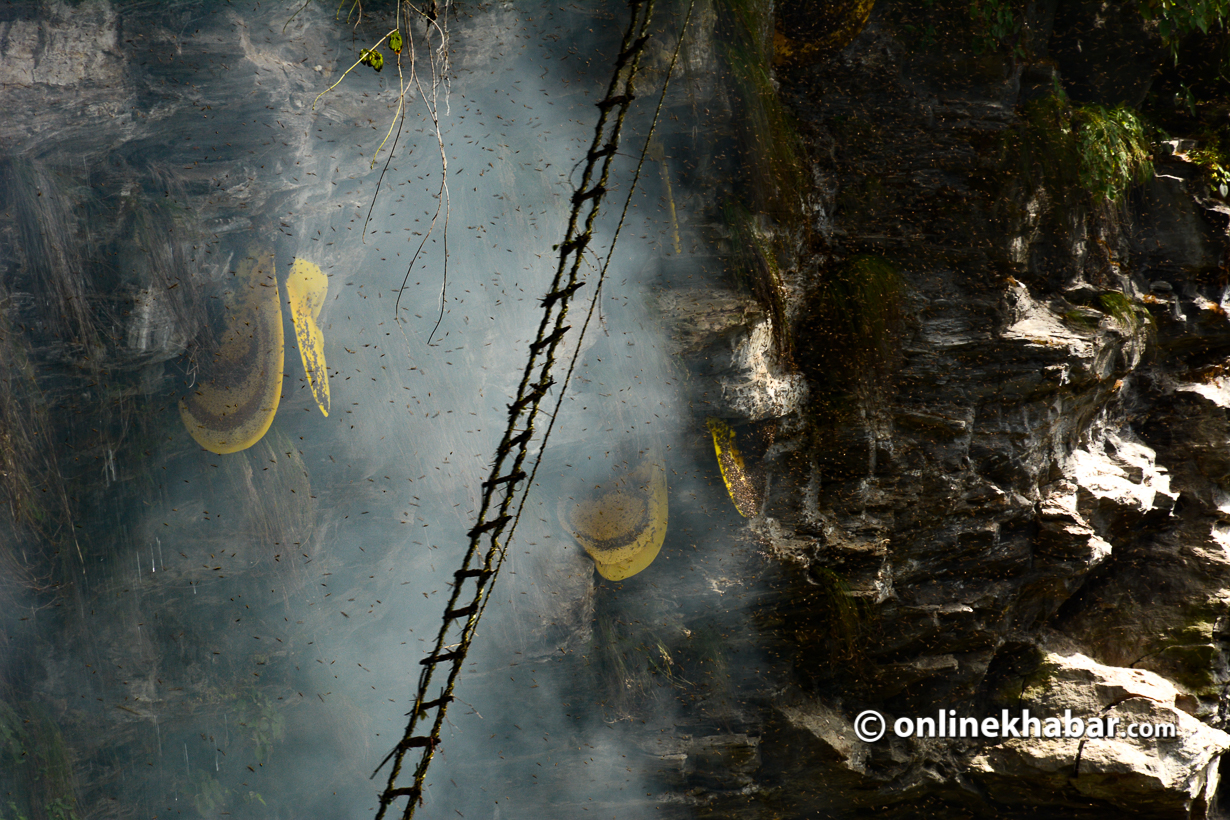
Grayanotoxin comes from rhododendron nectar. In spring, when the giant honey bees on our cliffs feed on rhododendron, the honey they make can carry enough of it to slow a person’s heart and drop their blood pressure. This is the honey sold abroad as “mad honey“, and it is the reason buyers in other countries pay so much for it.
The trouble is that nobody can tell how strong a jar is by looking at it or tasting it. In one laboratory study of Nepali honey, only 33 of 60 samples had measurable grayanotoxin, and among those that did, the strongest was about 86 times stronger than the weakest. A buyer who took one spoon of a weak jar last time may take the same spoon of a strong one this time.
The people paying for it
The Cliff Mad Honey Index keeps a log of every poisoning case published by a health authority or a medical journal since 2010. It now holds 73 people, treated in Hong Kong, Turkey, Nepal, Germany, the United States, Japan, Qatar and the United Kingdom. Where the source names the honey’s origin, Nepal is named 41 times, more than any other country. Nobody in those records died, and that is worth saying. But many arrived with a pulse in the thirties and dangerously low blood pressure.
Hong Kong alone reported nine people poisoned by Nepali honey in 2024 and 2025. Every one of those jars was carried or posted by a friend, a relative or the patient. This is not only an export problem. It travels in our own luggage.
At home, a review published this year in the journal Toxicon brought together 27 publications and about 68 Nepali patients, and noted that our hospitals have no way to test a patient for grayanotoxin. Doctors treat the symptoms and guess at the cause.
A market that grew faster than its rules
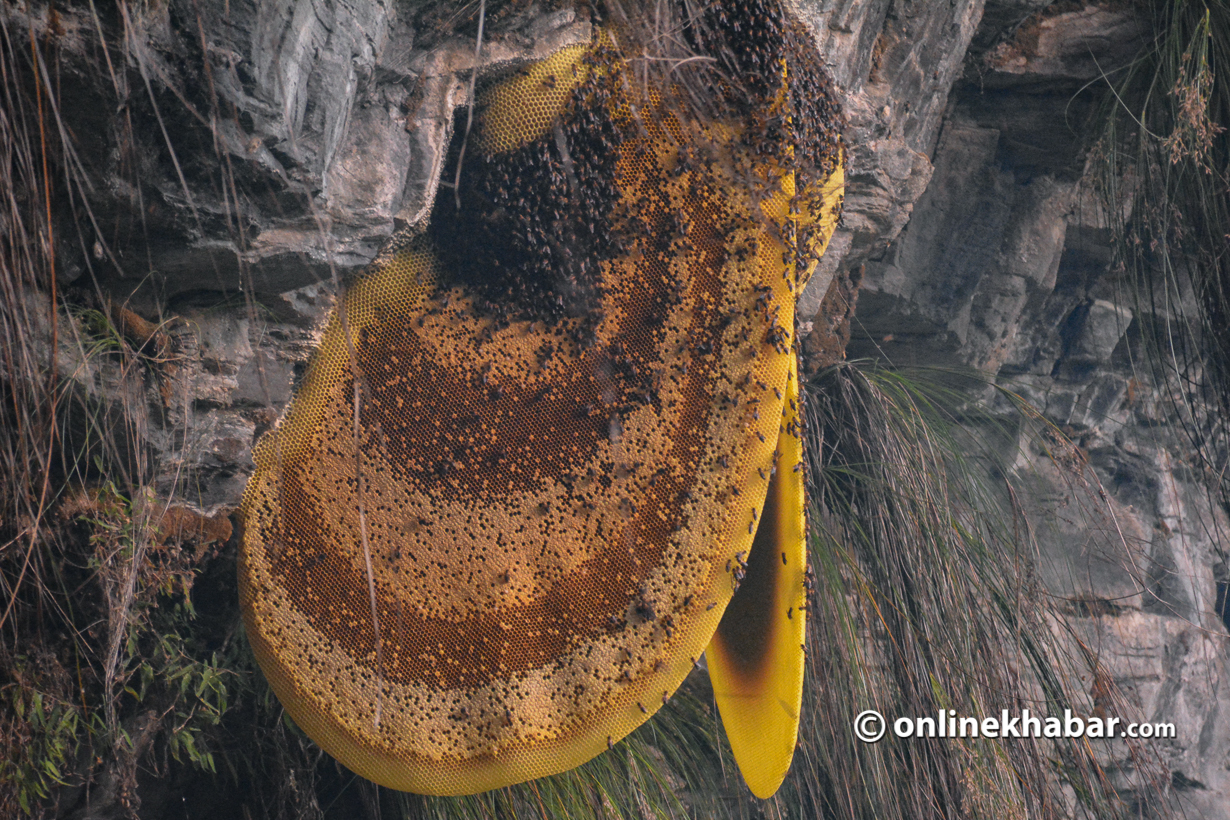
Honey exports have grown fast. Customs recorded Rs18.49 million in 2022/23; in 2025/26 the figure was Rs105.92 million, more than five times as much. Customs codes do not separate cliff honey from ordinary honey, so nobody knows how much of that is the spring honey from our cliffs. What we do know is the price gap. A litre fetches up to Rs4,000 in Lamjung, while sellers online abroad charge several hundred US dollars a kilogram.
As far as I can find, Nepal has no standard for grayanotoxin in honey and no rule that a jar must say what it contains or how it should be eaten. Buyers abroad rely on whatever the seller chooses to print.
We have seen where this leads. In 2002, Korean companies bought much of the spring cliff honey in advance. Since 2005, Korea has barred Nepali wild honey containing grayanotoxin. In April 2008, after a reported death, its food safety authority restated the ban and told travellers not to buy or eat it, and Korean food rules now require grayanotoxin to be “not detected” in honey. One of our best markets closed, and it was not our decision.
What a standard could look like
It does not need to be complicated, nor does it need to bring the trade to a halt. A few practical steps could make a significant difference. Every lot of cliff or “mad” honey leaving the country should carry a grayanotoxin test result from an approved laboratory, even if the result is classified into simple low, medium and high-risk bands.
The product should also be clearly labelled with its toxin level, harvest season and district of origin, alongside a plain warning advising consumers to start with a very small amount, avoid mixing it with alcohol and refrain from consuming it altogether if they are pregnant or taking heart or blood-pressure medication.
Traceability is equally important. Local governments, conservation areas and forest offices already issue permits for individual harvests. Linking each batch of honey to its corresponding permit would help distinguish genuine products from fakes, protect honest honey hunters and make it easier to monitor the colonies from which the honey is collected.
Finally, hospitals should have access to a reference laboratory capable of confirming grayanotoxin poisoning. This would give doctors greater certainty when treating patients and help establish reliable data on the scale of the problem, rather than relying on estimates and assumptions.None of this is radical. It is what any country does once a food it sells becomes valuable enough to cause harm.
Nepal’s honey hunters do some of the most dangerous work in the world, and their honey is now known far beyond the hills that produce it. That reputation can still go either way. We can set the standard ourselves, on our terms, while the trade is growing. Or we can wait for the next importing country to set it for us by closing its door, as Korea did in 2005. The alerts piling up in Europe suggest we do not have long to decide.