Kathmandu, September 7
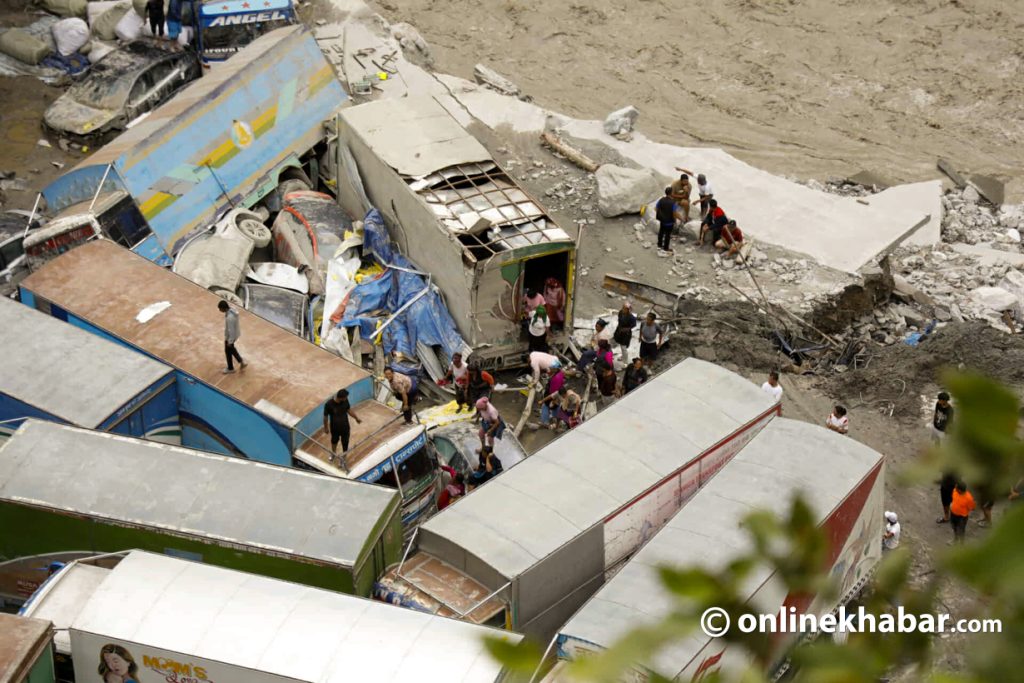
Nepal has asked the international community for advanced rescue equipment and specialised materials after technical difficulties intensified search and rescue operations following the devastating floods in the Bhotekoshi River.
According to the latest update issued by the Ministry of Foreign Affairs on Monday, the government has prepared a list of high-tech rescue equipment and appealed for international assistance to accelerate rescue operations and reduce risks in the affected areas.
Nepal has sought assistance from foreign missions and friendly countries after its own technical capacity proved insufficient to rescue people trapped inside hydropower tunnels and search areas inaccessible to rescuers because of thick mud and debris.
The government has requested high-capacity drones and LiDAR technology to scan difficult terrain, landslide-affected areas and tunnel interiors in the search for missing people.
It has also requested mud/tunnel rescue suits designed to allow rescuers to safely enter areas filled with thick mud and hydropower tunnels.
Similarly, Nepal has sought high-capacity pumps to rapidly remove water and mud accumulated in flooded areas and tunnels.
The government has also requested Bailey bridges to quickly restore road connectivity by replacing bridges swept away by the floods, as well as DNA testing kits and laboratory freezers for the identification of victims.
Nepal has also appealed for materials to prevent outbreaks of infectious diseases in the disaster-affected areas. The government has requested medical and health supplies needed to control communicable diseases and possible epidemics following the disaster.
The Ministry of Foreign Affairs said tunnel rescue suits and LiDAR technology have become an immediate necessity because people may still be trapped inside tunnels and the thick mud has increased the safety risks involved in manual rescue operations.
The government believes that obtaining these technologies would make the search, rescue and identification of missing people significantly faster and more effective.
Specialised teams from five countries deployed
According to the ministry, specialised teams from five countries have been deployed to rescue people trapped inside tunnels.
In coordination with the Nepali Army, Nepal has mobilised specialised tunnel rescue teams from India, China, South Korea, the UAE and Malaysia.
The ministry said rescue operations are continuing at affected hydropower projects including Upper Trishuli 1, Upper Trishuli 3A, Upper Trishuli 3B, Chilime, Rasuwagadhi and Langtang.
Additional equipment and technical personnel are being deployed to sustain rescue operations at the affected projects.
Rescue equipment, high-capacity drones and heavy-lifting equipment received from neighbouring countries, friendly nations and the international community are being used in the operations.
For the search for missing people and identification of bodies, forensic teams from India, China, Japan, Singapore and South Korea are working with Nepal Police on DNA collection and analysis.
The ministry said Prime Minister Balen Shah and Foreign Minister Shishir Khanal have been holding regular telephone conversations with their counterparts around the world to strengthen disaster response efforts.
On Monday, Khanal held a telephone conversation with Maldivian Foreign Minister Ibrahim Khaleel.