
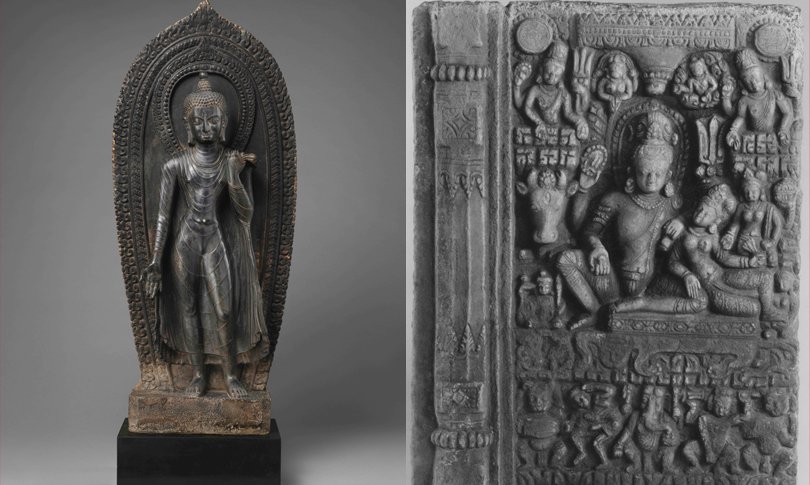
I have been working in heritage repatriation and restitution silently for almost 3 years. It was challenging in many ways, but I learned some important realities that deserve discourse when we talk about the theft of our gods, our history, our arts, and our heritage as a whole.
As a researcher, I have always found archives to be one of the strongest foundations for any research, as they are for repatriation and restitution as well. As a researcher, I have always considered archives to be one of the strongest foundations of any serious research. The same is true for repatriation and restitution. Yet, sometimes, archives can also create an unexpected irony. A book titled Images of Nepal was published in 1984, and soon after, our deity Laxmi-Narayan was stolen from its home in Patko Tole, Patan. Was this simply a coincidence?
I am not blaming the author in any way. In fact, the book is an important and valuable piece of documentation. But the situation raises a question that is difficult to ignore. Books, photographs, and archival publications are essential for recording and preserving knowledge about heritage. At the same time, when Nepal’s sacred objects are photographed, identified, located, and described in detail, such publications also make information about them accessible to an international audience. In that sense, the very documentation intended to preserve the memory and knowledge of our heritage may, unintentionally, have also made vulnerable objects more visible to those who wished to remove them.
Before we question the security system through a colonised lens, we first need to understand the context in which Nepal’s heritage exists. In Nepal, small shrines and temples are there every other mile or half; it is because we did not believe in hiding our gods; we believed in celebrating them in every way possible by every community. This relationship with heritage is also closely connected to the constitutional protection of culture, including the right to language and culture guaranteed under Article 32 of the Constitution of Nepal.
Nepal have always been in attraction of western world in accordance to the heritage. The way the Western world has never been able to rise from the colonial mindset is the very reason they see our heritage and our gods as commodities, and as objects. Well, this brings me to the question of whether our laws were influenced by the very same mindset. If you look at the Ancient Monuments Act, 1956 A.D, section 2 (b) defines heritage with the particular word “object”. The word object constrains the rich heritage of indigenous communities that they have been celebrating for generations; the living gods they worship every day are limited to objects of commodification. This problem is not confined to foreign museums. It also requires us to look critically at our own legal vocabulary.
Books such as “Art of Nepal” and “Nepal where the gods are young” have played an important role in introducing Nepal’s heritage to international audiences, but some of the narratives and visual choices in these publications can also be questioned. The cover of these books indicates the enticing of Nepal’s idols. This wrong narrative not only attracts the Western world; it also detaches the community from their heritage and their rituals. I find this much more absurd: propaganda of detaching the community from their gods so that, when our gods are taken away, the community avoids it. And there persists the idea of tantric intimacy, which in reality does not exist.
Our gods and history in many ways face an identity crisis. International museums, auction houses and so forth intentionally or unintentionally write the names of artefacts and paintings wrong, which not only misleads the audience but also hides the identity of the very artefact. Sometimes the origin of the artefacts is misleading; we can clearly see it is from Nepal but in the provenance it is written as Tibet or India to create the geographical dilemma. For example, the National Museum of Asian Art has a painting from Nepal of Girvan Yuddha Birkam Shah but mentions its origin as India.
Another heart-wrenching fact is that they always misguide our goddess. They have limited our goddess’s power to motherhood, beauty and consort. For example, the Los Angeles County Museum of Art (LACMA) has Nepal’s The Androgynous Form of Shiva and Parvati (Ardhanarishvara), where they have well described Shiva but have constrained Parvati as Shiva’s consort, which is demeaning to Nepal’s heritage. It mentions Siva and Uma; well, it’s either Siva-Parvati or Uma-Maheshwor, not Siva and Uma.
Another example is the Chakrasamvara and Vajravarahi from C. 1500, which in collection of Philadelphia museum; the title in its provenance is “Chakrasamvara and Vajravarahi in Sexual Embrace”. While describing it depicts as, “dark blue-skinned Chakrasamvara stands locked in sexual embrace with his bright red consort Vajravarahi,” whereas we have always known this only as a union of enlightenment and wisdom. Well, they have admitted that this is the Newa style painting; however, they have left the geographical space empty in their object details. Our gods are taken to the market illegally and they are forced to lose their identity and are given a defaming identity to satisfy the market’s needs.
Furthermore, the Metropolitan Museum of Art (MET) also has in its collection on the title “Plaque from a Tantric Ritual Apron (Chakrasamvara and Vajravarahi at Centre)”, dated around the 16th century. Another appealing word, “Tantric,” is used to mystify our heritage just to make it more saleable! The main problems arise with descriptions of “tantric intimacy” or other eroticised interpretations that do not reflect the actual beliefs, practices, or meanings understood by the communities themselves. This is another level of misinterpretation. Let us discuss the proved example: The Guardian’s 2026 editorial on the Upton Lovell Shaman may appear unrelated to Nepal, but it offers an important methodological lesson. For years, the high-status Bronze Age burial was assumed to be male. Ancient DNA analysis later identified the individual as female. The mistake did not arise because the evidence clearly proved the person was a man; rather, an assumption about gender and status became embedded in interpretation and was repeated until new evidence forced scholars to reconsider it.
Institutions should take the same lesson seriously when interpreting cultures that are not their own. Labels can look authoritative even when they contain inherited assumptions. A museum may know the date, material and iconography of a Nepalese piece and still misunderstand its social life. A scholar may correctly identify a tantric motif but overstate sexuality because that is the category most legible to a Western audience. A collector may know the stylistic school while knowing nothing about the shrine from which the image disappeared. Expertise should therefore be accompanied by humility, and interpretation should be open to correction by source communities, ritual specialists and new research.
The 2023 case involving Italian artist and teacher Tiziano Ronchi at the Taleju Temple area in Bhaktapur shows another dimension: the vulnerability of sacred heritage even in a highly significant protected place. Contemporary Nepali reporting stated that an eyewitness, Suresh Kawan, saw Ronchi apparently using a knife near a metal component of a sacred object and alerted Nepali Army personnel. Ronchi was arrested and investigated under heritage law. He disputed the allegation, and later Italian reporting stated that he was not found guilty of the alleged theft and that the matter concluded with a 50,000-rupee administrative fine. Any fair account must include both the allegation and the outcome.
What matters for the present discussion is the role of local vigilance. A witness noticed conduct that appeared suspicious, questioned it, and informed the guards. Heritage protection often fails when communities are treated as passive beneficiaries while all authority is placed in distant institutions. In reality, the person who walks past the shrine every morning may notice immediately what a centralised office will discover weeks later. Community custodians, residents, priests, guthi members, municipal staff, police and archaeological authorities should therefore be treated as part of one protective network, not as separate worlds.
While we discuss the international market, we tend to delineate it from the organisations that are actually putting in an effort to help countries like Nepal; one is the Association for Research into Crimes against Art (ARCA), ALIPH, and the Swiss Government in coordination with Namuna Foundation; even the Carabinieri, Command for the Protection of Cultural Heritage, are of immense help. It has been a great help for the activists and Namuna Foundation itself to work in the field of heritage crime.
“Our gods are living” If you wonder what that means, it means that they are living a dignified life within the community they belong to. They are woke up every morning by the community by lighting the diyo, ringing bell as an alarm and then cleaning them, feeding them with water and food, we share our sorrows to our gods, we cry in front of them, we share our happiness, we share secrets that we cannot share to others, this continues for the entire day and even during the evening they are again worshipped and fed. This is why our gods are living and they are meant to live a dignified life followed by a dignified death. We do not believe that our gods should be kept inside the glass box in a museum to be conserved; we are meant to live with them.
When I see our gods in the museum, I feel like our gods are suffocating; they are inside ventilators. They are waiting for the community to take them back to where they belong. One thing I must clear out is our gods do not belong to museums, private collections or auction houses; they are not for someone’s gratification. They belong to the community. They belong to us, and anyone saying anything beyond that is influenced by the Western colonisation mindset.
The theft of Nepal’s gods cannot be understood only through police files, customs records, auction catalogues or museum inventories. It is also a story about power: who has the authority to name, interpret, classify, possess and display the sacred life of another community. The market takes the deity physically. The museum can take it conceptually. The law can reduce it administratively. Scholarship can misunderstand it. And all of these processes can occur while the community that lived with the deity is treated as a secondary voice.
Our task is not to reject scholarship, museums, conservation or documentation. We need all of them. But we need them to work differently: with provenance, humility, consent, community knowledge and an understanding that some things called ‘objects’ are still living within relationships. The question is not whether the world may learn from Nepal’s heritage. It should. The question is whether learning requires possession, removal or control over meaning. It does not.
When a god is stolen, a space is left empty in more than a temple. A ritual is interrupted. A neighbourhood changes. Memory is wounded. And when that god returns, the real measure of justice is not that the object has crossed the border back into Nepal. Justice begins when the deity can once again belong, breathe and live within the community from which it was taken.