Kathmandu, September 4
A lake formed after a landslide triggered by a falling ice-rock mass on the north face of Langtang Lirung is not considered a risk at present, according to Nepal’s Flood Forecasting Division.
The division’s chief, Binod Parajuli, said a Chinese team monitoring the area had informed Nepali authorities that although the water level in the upper lake had increased slightly, it had not reached a dangerous level.
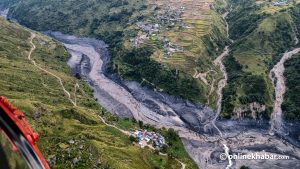
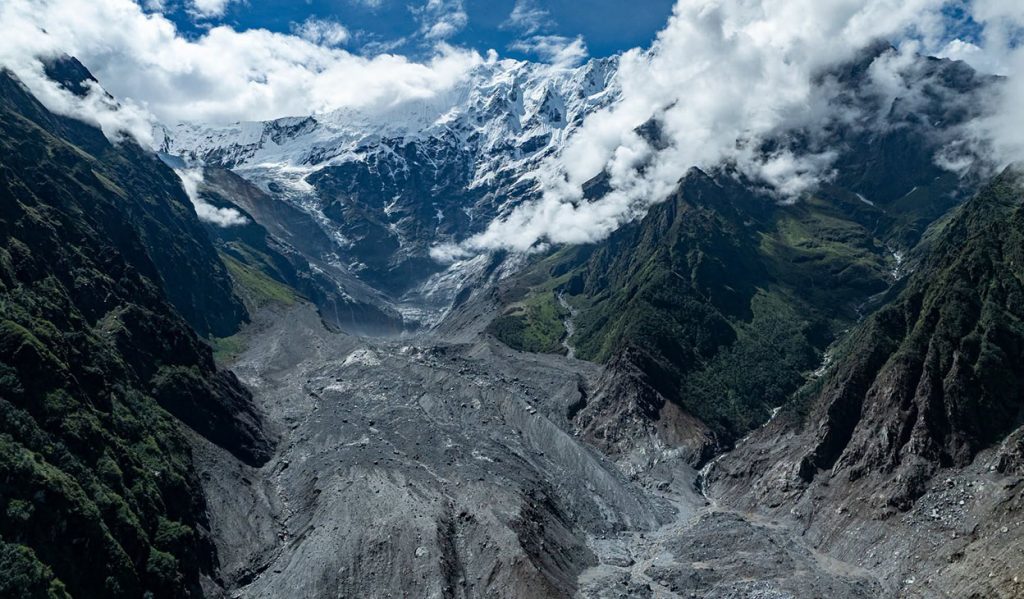
Two lakes were formed after the ice-rock mass fell from the north face of Langtang Lirung. The first depression formed downstream, while a second formed higher up along the upper section of the Lhende Khola.
The Chinese team has referred to the lake near the stream as Barrier Lake One and the upper lake as Barrier Lake Two.
“Almost all the water from the lower lake has already flowed out, so there is no significant accumulation of water and there is not much of a problem,” Parajuli told Onlinekhabar. “The water level in the upper lake has increased somewhat, but we have been informed that it has not reached a dangerous level.”
According to Parajuli, the Chinese team has been observing the area on the Chinese side of the border and monitoring the Nepali side across the Lhende Khola. It has been regularly sharing information about the lakes with Nepali authorities.
The upper lake covers approximately 0.19 square kilometres. The water level there has risen by about two metres, with an estimated 600,000 cubic metres of water now accumulated in the lake.
“The Chinese team has been continuously providing information about the lake,” Parajuli said. “Based on the situation so far, their assessment is that there is no immediate risk from the water in the lake.”
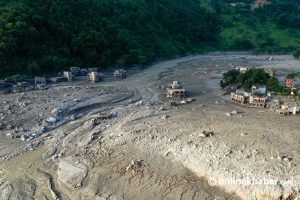
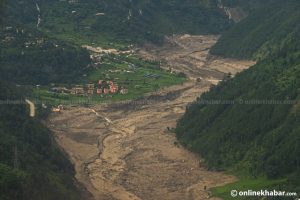
Two lakes were formed near the Nepal-China border in the northern part of Langtang Lirung following the Rasuwa flood on August 26.
Four days later, the lower of the two lakes breached, sending water downstream and triggering another flood in the Bhotekoshi River.
Parajuli said the second flood caused the lower lake to drain, leaving the upper lake as the one currently being monitored.