Kathmandu, September 3
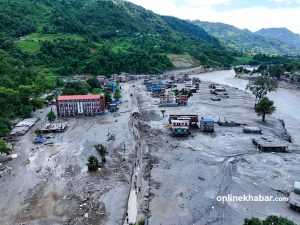
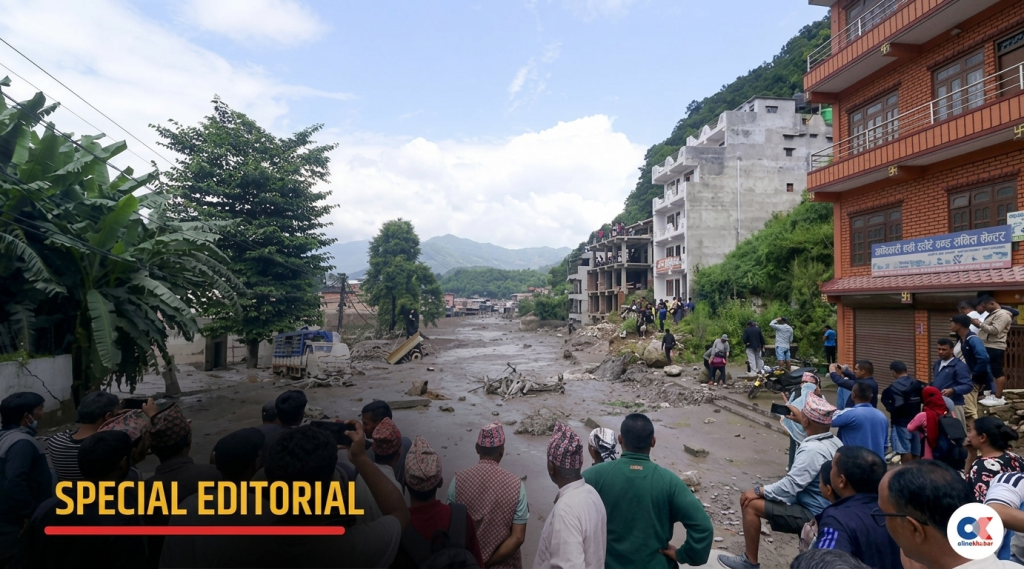
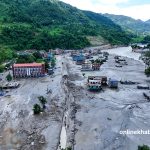
Efforts to clear the entrance to the 160-metre-long cable duct tunnel of the Trishuli-3A Hydropower Project have been intensified following the devastating Bhotekoshi flood in Rasuwa on August 26.
More than two dozen large boulders have so far been blasted away from the portal area as engineers and rescue teams work to remove mud, rocks and other debris accumulated after the flood, according to engineer Udayaraj Neupane, who is involved in the search and rescue operation.
Two excavators have been operating regularly since August 29. In five days, they have removed around 20,000 cubic metres of mud, sand, rocks, concrete slabs, beams, pillars and boulders as large as houses, Neupane said.
The clearance operation is continuing around the clock, with breakers and controlled explosives being used wherever necessary.
Neupane said workers have so far cleared a roughly 50-metre stretch of the portal area, reaching about 2.5 metres below the top face, or crown, of the tunnel.
The Trishuli-3A cable duct is 5.5 metres high. Work to construct an access and drainage passage through the remaining roughly three metres of debris must be completed before workers can begin clearing the mud accumulated inside the tunnel, he said.
Initial signs suggest no water has accumulated inside tunnel
Preliminary observations indicate that the section of the tunnel extending about one metre inward from the entrance is completely filled with mud.
However, water is flowing out of the tunnel at a rate of around two litres per second, with no signs of pressure, Neupane said.
This suggests that water has not accumulated inside the tunnel. At the outer portal, workers have found a gate slab, two large tree trunks and large boulders obstructing the entrance.
Based on the initial assessment, large rocks may not have entered the tunnel, apart from water and mud, Neupane said. The actual condition of the tunnel’s interior, however, has yet to be fully confirmed.
Tunnel structure believed to be intact
The 160-metre-long Trishuli-3A cable duct has a bend at around the 60-metre mark. The tunnel also rises towards the powerhouse, which has led engineers to make a preliminary assessment that its inner section is likely to be in normal and safe condition.
However, this can only be confirmed once the debris blocking the entrance is removed and the tunnel can be properly inspected, Neupane said.
The site has no road access, meaning machinery and materials needed to repair equipment have to be transported by helicopter.
This has caused some delays in bringing necessary materials to the site, but the overall rescue and debris-clearing operation is continuing without interruption, Neupane said.