

Kathmandu, September 1
Seven days after a devastating flood swept through the Bhotekoshi–Trishuli corridor, rescue teams are still struggling to reach workers believed to be trapped inside tunnels at several hydropower projects in Rasuwa and Nuwakot.
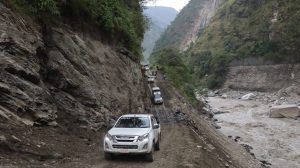
Families and project officials say rescue efforts have been slowed by difficult terrain, mud and debris inside the tunnels, and delays in bringing the heavy equipment needed to clear access routes.
At the Trishuli 3B hydropower project, 198 employees and workers remain out of contact following the flood.
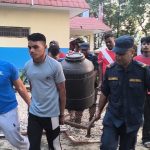
Bibek Pandey, whose father Kamal Pandey, a team leader and engineer at the project, is among those missing, said the family had been waiting for a stronger rescue operation since the disaster.
“We have been here since Friday, appealing to the government. The government is trying, but it does not feel like enough,” Pandey said.
According to him, the family and project officials had been trying to bring an excavator to the site since Friday, but the machine only arrived on Monday.
Officials initially said the area was covered in deep mud and could not be accessed. A reconnaissance on Monday, however, found a possible route into the site.
Pandey said a larger rescue operation was now needed, with 200 to 300 personnel and several excavators deployed simultaneously.
The first 72 hours after a tunnel accident are generally considered critical for rescue. However, a week after the flood, authorities have yet to successfully reach those believed to be trapped inside several hydropower tunnels.
Rescue teams face mud, debris and blocked access

At the Chilime Hydropower Project, project chief executive officer Bhairaja Maharjan said technical workers were still waiting to be rescued.
The Nepali Army and an Indian Army team entered the tunnel to assess the situation, but thick mud and debris have prevented further progress.
“The army teams went into the tunnel yesterday and today, but mud has entered the tunnel. Excavators and other equipment needed to remove it have still not reached the site,” Maharjan said.
He said only small amounts of mud and debris had so far been removed.
“There is an ocean of it there. The work done so far is like removing one litre of water,” he said.
A body recovered from the Chilime tunnel was also not that of any of the project’s missing employees, according to Maharjan.
At the privately operated Langtang Hydropower Project, the Nepali Army team entered around 100 metres into the tunnel on Monday before being stopped by a large boulder.
Project promoter Bijayman Bhattarai said the army had asked for equipment to clear the obstruction but the necessary machinery had yet to reach the site.
“We proposed a joint rescue operation once the equipment is taken there,” he said.
Bhattarai said it was unusual that no successful rescue had been carried out even seven days after the disaster.
Rescue at Upper Trishuli-1 also continues

At the 216 MW Upper Trishuli-1 project, 573 people remain out of contact, according to project sources.
The government gave permission on Tuesday for some rescue equipment to be transported from Kathmandu, but heavy machinery such as excavators has still not reached the project site.
Chinese and Nepali Army teams have entered through an access tunnel to assess conditions and search for missing workers.
Rescue teams have also been working at Upper Trishuli-3A, where they are trying to create an alternative route into the tunnel.
An engineer involved in the operation said a location had finally been identified where equipment could be taken inside.
A Bobcat machine is being brought to the site in an attempt to clear a path into the tunnel.
The flood damaged 12 hydropower projects in Rasuwa and Nuwakot. According to figures provided by the projects, 894 employees and workers remain out of contact, although it is not yet known how many are actually trapped inside tunnels.
Based on information from the projects, officials estimate that around 600 people could be inside the affected tunnel systems.
Calls grow for wider participation in rescue

Questions have also been raised over why the government did not bring in more domestic and international rescue expertise earlier.
India and China offered rescue personnel and equipment immediately after the disaster, while South Korea also prepared to send a rescue team.
However, foreign rescue teams were only allowed to begin operations several days after the disaster.
Domestic rescue groups and technical organisations have also complained that they were kept on standby despite offering assistance.
Tulsi Gurung, president of the Nepal National Mountain Guide Rescue Association, said his team had sought permission to participate in rescue operations from the day of the disaster.
He said the team had expertise in rope rescue, helicopter long-line rescue and accessing difficult terrain, and was ready with the necessary equipment.
“Every hour is important in rescue operations,” Gurung said, urging authorities to immediately mobilise Nepal’s available technical rescue and long-line rescue specialists.
The Nepal Engineers’ Association has similarly criticised the delay and said engineers and technical personnel offered by the association had not been adequately involved.
Association president Subash Chandra Baral said the organisation had been coordinating with the government to provide technical assistance but had not been given sufficient opportunity to contribute.
According to Baral, the government initially placed tunnel rescue at a lower priority while focusing on other rescue operations.
Private hydropower companies now allowed to join
The government had initially adopted a single-command system under which the Nepali Army led rescue operations at the affected hydropower projects.
Project operators were not allowed to independently conduct rescue operations.
After seven days without the expected results, however, the government has now asked hydropower companies to join the search and rescue effort with their own technical personnel and equipment.
Nepali Army spokesperson Rajaram Basnet said the army had not withdrawn from the operations and that private project promoters had been asked to work alongside the military.
“We have asked the private-sector promoters to join us,” Basnet said.
He said the army was continuing to coordinate with project officials at sites including Rasuwagadhi, Langtang and Chilime.
The continuing rescue effort comes amid uncertainty over the fate of hundreds of workers in the affected hydropower projects.
For families like the Pandeys, however, the focus remains simple: reaching the tunnels as quickly as possible and finding out whether their missing relatives are still alive.