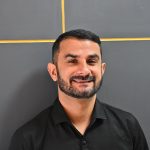


Before he was modelling viruses on computers in the United States, Dr Naveen Vaidya was a boy in Sindhuli studying under the faint light of a kerosene lamp.
His childhood was marked by loss. His father, a government employee, died when Vaidya was still young, leaving his mother as the family’s only support. She worked in the fields and took on small jobs to educate her children.
Every day, Vaidya walked for about an hour, up and down the hills, to reach school. At home, while his mother worked from morning until evening, he immersed himself in his studies.
The hardships, however, did not stop him. They pushed him forward.
Today, Vaidya is a professor at San Diego State University (SDSU) in the United States, where he uses mathematics to understand how diseases spread. His research has examined viruses including HIV, hepatitis and Covid-19, as well as diseases such as malaria, rabies, dengue and lumpy skin disease using mathematical models.
But his work has never been limited to laboratories in the US.
For years, Vaidya has worked to connect Nepal’s students and researchers with international scientific networks. He has helped establish research partnerships between Nepali institutions and SDSU, organised international programmes in Nepal and supported students pursuing PhDs and research careers.
His journey from a remote village in Sindhuli to the laboratories of North America began with a mother who refused to let hardship determine her children’s future.
A childhood shaped by loss
Dr Naveen Vaidya was born in Jhangajholi village of Ratmata in Sindhuli, surrounded by green forests, the Sunkoshi River and hills rising around the settlement.
His family struggled financially.
His father worked as an ordinary government employee but died while Vaidya was still a child. Losing his father meant growing up without the person whose hand he had once hoped to hold.
His mother became the family’s sole source of support.
She worked in the fields and took on whatever small jobs she could to keep the family going and ensure her children could study.
For Vaidya, education became a way forward.
He completed his early schooling in the village. The memory of reading books in a dim room filled with smoke from a kerosene lamp has stayed with him.
Getting to school meant walking for an hour through difficult terrain. But rather than discouraging him, the difficulties strengthened his determination.
He eventually began producing excellent results at school, becoming a source of pride not only for his own village but for neighbouring communities as well.
From Kathmandu to the world
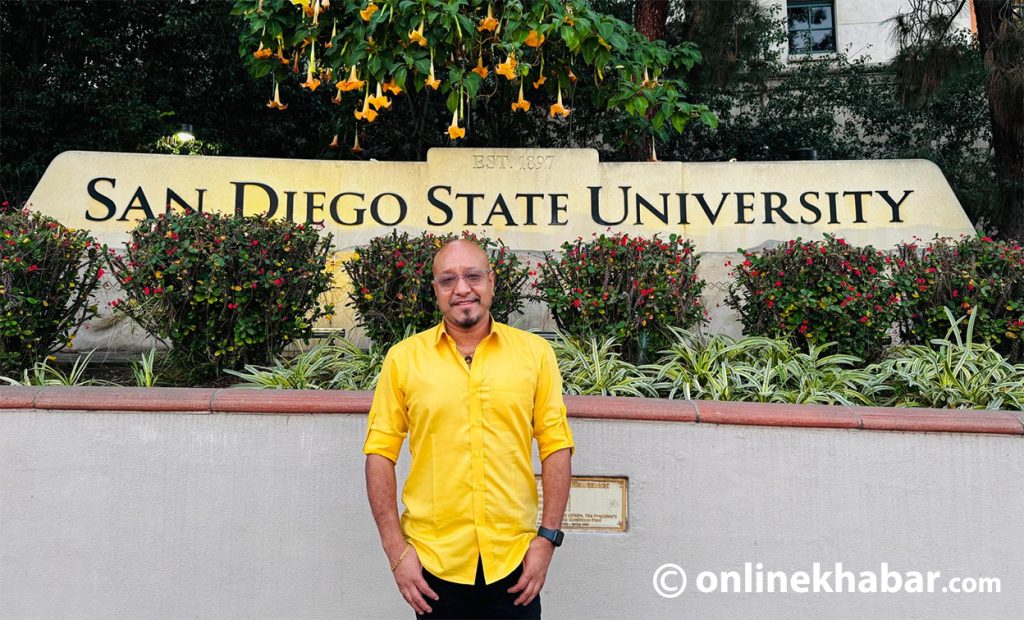
After completing school, Naveen Vaidya moved to Kathmandu with bigger ambitions.
For someone from his village, the capital was another world. Surviving there was not easy, but he worked part-time while continuing his education.
He studied science at Patan Multiple Campus, completed his bachelor’s degree at Tri-Chandra College and earned a master’s degree in mathematics from Amrit Science Campus.
He also began teaching mathematics at schools and colleges in Kathmandu.
But he wanted to go further.
Vaidya realised that while Nepal provided a strong foundation in theoretical knowledge, pursuing research at an international level required opportunities that were difficult to find at home.
That ambition eventually took him abroad.
From Canada to the United States
Dr Naveen Vaidya enrolled at York University in Canada, where he pursued a master’s degree in industrial and applied mathematics before beginning his PhD.
His research focused on the mathematical modelling of membrane fusion between influenza viruses and human cells.
The research was distinctive enough to earn him York University’s prestigious Susan Mann Dissertation Award.
After completing his PhD, Vaidya went on to work at leading research institutions in the United States and Canada.
He completed postdoctoral research at Los Alamos National Laboratory and later became a fellow at the University of Western Research in Canada.
He then joined the University of Missouri-Kansas City as an assistant professor.
In 2017, he moved to San Diego State University, where he remains a professor.
Using mathematics to understand disease
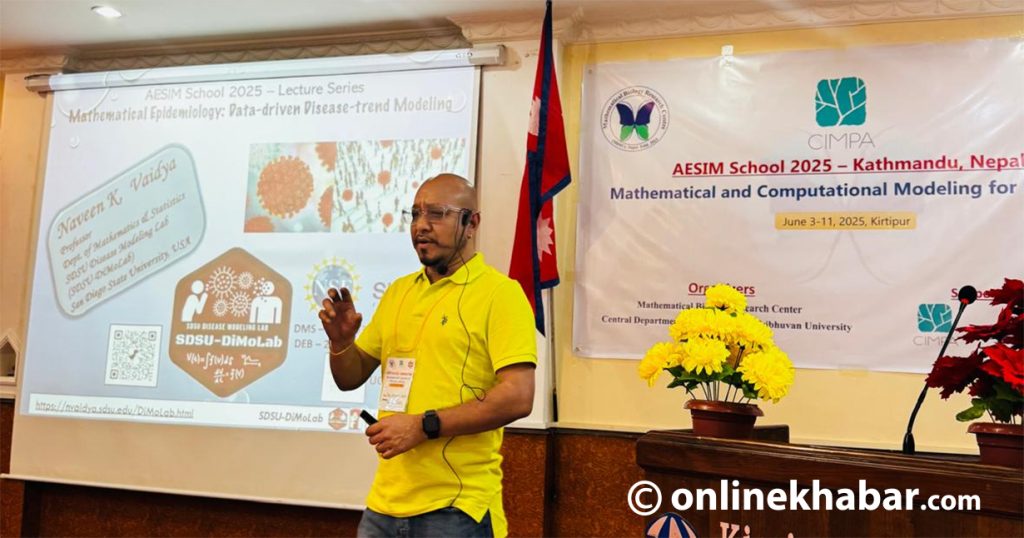
Dr Naveen Vaidya studies disease from a different perspective.
He is not a doctor treating patients. He is a mathematician trying to understand what happens inside populations and bodies by turning disease processes into mathematical models.
His research has examined the dynamics of viruses including HIV, hepatitis and Covid-19.
He has also developed community-level mathematical models using data from Nepal to study diseases including Covid-19, malaria, rabies, dengue and lumpy skin disease.
For Vaidya, mathematical modelling is more than an academic exercise. It can provide important evidence for designing disease-control strategies.
His research has earned him four National Science Foundation grants, two Simons Foundation grants and more than 20 international research grants.
His work has appeared in more than 61 international journals, and he has delivered more than 125 research talks around the world, including keynote speeches.
Keeping Nepal in the equation
Despite building his career abroad, Dr Naveen Vaidya has remained closely connected to Nepal.
“Even though Nepal has limited resources and technology, its potential is unlimited. So wherever I am, I always think about contributing to the country,” he says.
That belief led to the 2019 CIMPA Summer School in Mathematical Biology in Nepal.
The programme was more than a short academic event.
Participants presented their work at the AMNS-2019 conference, while some went on to publish their research in prestigious journals. Others began long-term collaborations with scientists in the United States and Canada.
Perhaps most importantly, the programme helped strengthen cooperation between Tribhuvan University and San Diego State University.
The partnership eventually helped three students complete their PhDs under the supervision of Vaidya and Dr Kedarnath Upreti.
One of them, Dr Khagendra Adhikari, is now conducting collaborative research in Taiwan with support from a Taiwanese government scholarship.
Another eight students are currently pursuing PhDs at Tribhuvan University.
The collaboration also received funding from IMU’s Commission for Developing Countries (CDC), with each scholarship recipient receiving more than Rs 1.2 million in support.
During this period, the Nepal Health Research Council, the Central Department of Mathematics at Tribhuvan University and SDSU formally signed a research partnership.
It was an important step towards bringing mathematics into Nepal’s policy and public health discussions.
Building a scientific community
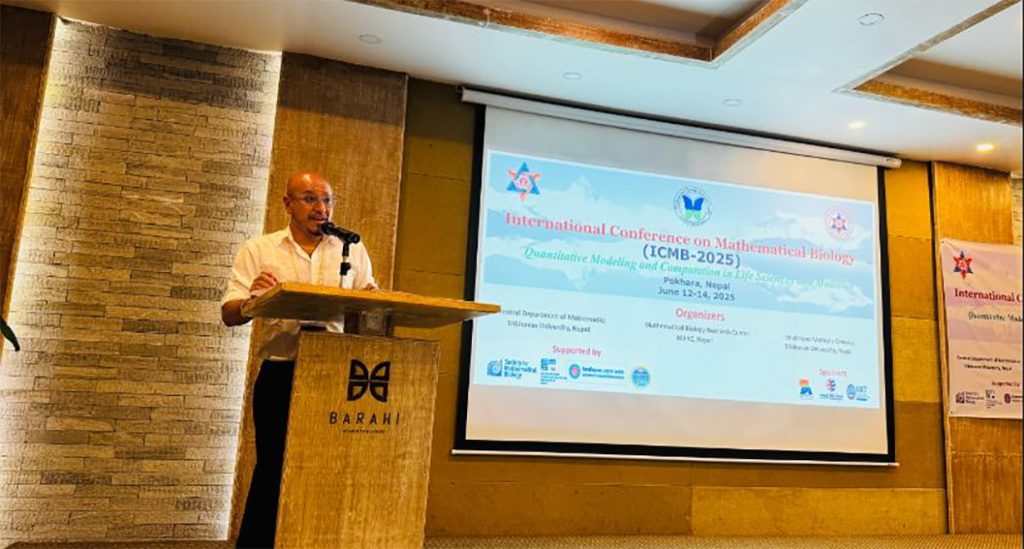
In 2023, Dr Naveen Vaidya and his colleagues established the Mathematical Biology Research Centre Nepal.
International programmes continued in the following years, including the SIMPA curriculum, AESIM School in Kathmandu and ICMB-2025 in Pokhara.
Researchers from 14 countries, including Nepal, took part in these programmes.
For Vaidya, the goal is not simply to bring international scientists to Nepal. It is to create a sustained scientific network in which Nepali researchers can collaborate, publish and develop opportunities beyond the country’s borders.
A weekly connection to Nepal
His connection with Nepal has also become part of his weekly routine.
“When it is 7am on Saturday in Nepal and Friday evening in San Diego, I join a Zoom meeting with my research group,” he says.
The meetings usually last two to three hours.
Researchers discuss ongoing work, exchange new ideas, debate recent findings and plan future projects.
Dr Naveen Vaidya has maintained these meetings for the past six years.
For Nepali students and researchers, the sessions offer direct exposure to international research practices. They also allow knowledge and skills to flow continuously between Nepal and its scientific diaspora.
Over time, the relationship has become more than a bridge between Nepal and the US. It has developed into a kind of living laboratory, where ideas can move freely despite borders and time zones.
Writing the mathematics of disease
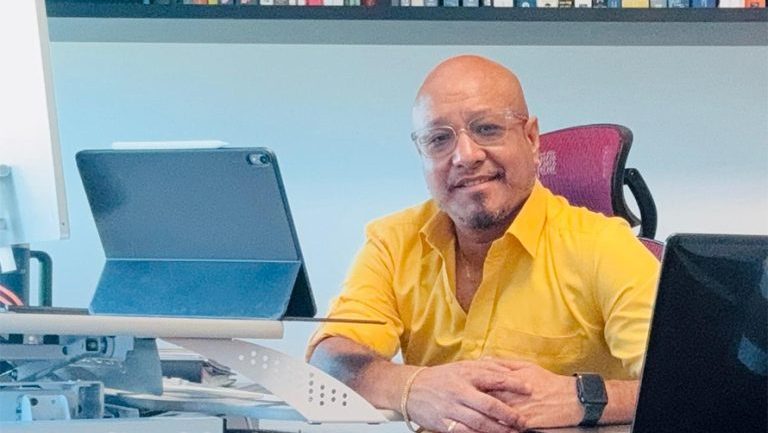
Today, Dr Naveen Vaidya lives in the United States and works on the mathematics of disease.
But his story began thousands of kilometres away, in the dim light of a kerosene lamp in Sindhuli.
There was the loss of his father, the struggle of his mother, the long walks to school and the move from a village to Kathmandu. Then came the universities and laboratories of Canada and the United States.
Each stage added something to the scientist he would become.
Baidhya’s journey is a reminder that world-class scientific careers do not always begin in well-equipped laboratories. Sometimes they begin in ordinary villages, with limited resources, a determined parent and a child willing to keep studying.
And even after reaching the other side of the world, Vaidya has continued to look back—using the knowledge he has gained abroad to build opportunities for the next generation of researchers in Nepal