

Kathmandu, August 20
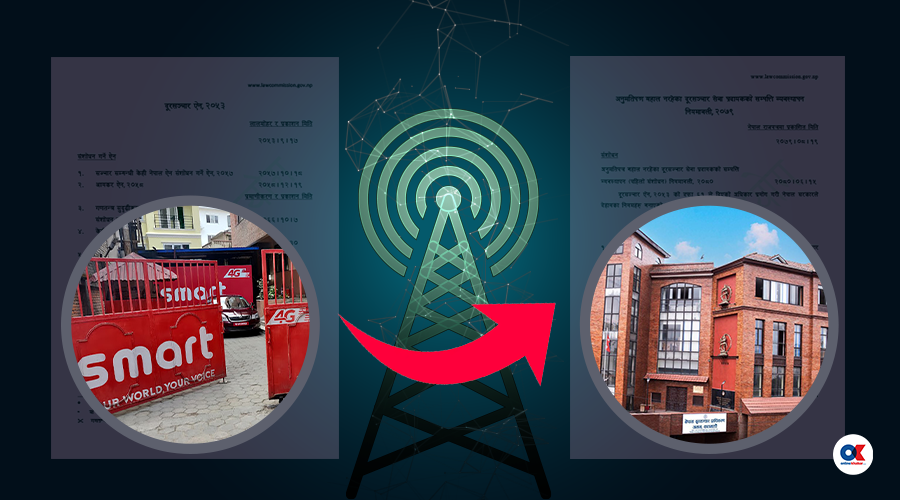
A dispute over ownership of physical assets belonging to telecom companies whose licences have been revoked has resurfaced following a government case related to the alleged auction and sale of Smart Telecom’s towers and other assets pledged as collateral to banks.
The issue has become particularly contentious after the Nepal Telecommunications Authority (NTA) revoked Smart Telecom’s licence on April 17, 2023.
The question of who owns a telecom company’s towers, equipment, buildings and other physical infrastructure after its licence is revoked had already emerged in 2022, when the government introduced regulations that legal experts say appear to conflict with the Telecommunications Act.
Act and regulation appear to contradict each other
Section 33 of the Telecommunications Act, 1997 states that, when the licence of a telecom service provider with more than 50 percent foreign investment expires, ownership of its land, buildings, machinery, equipment and structures related to the service transfers to the government.
This provision suggests that the physical assets of telecom companies with less than 50 percent foreign investment—or those fully owned by Nepali investors—do not automatically become government property when their licences are revoked.
However, the government subsequently introduced the Regulation on Asset Management of Telecom Service Providers Whose Licences Are No Longer Valid, 2022.
Rule 18 of the regulation states that the entire assets, telecommunications infrastructure, structures and networks of telecom companies whose licences have been revoked or expired will come under the Nepal Telecommunications Authority.
The government has relied on this regulation to claim that Smart Telecom’s assets came under its control.
Legal experts, however, argue that a subordinate regulation cannot override an Act passed by Parliament.
According to them, if there is a conflict between a law enacted by Parliament and a regulation framed by the executive, the provisions of the parent Act prevail.
A telecommunications sector expert said the government cannot claim private property simply by introducing provisions through regulations that are not contained in the Act.
“An issue cannot be resolved simply by publicly questioning the regulation as long as it has not been formally challenged in court and declared unlawful,” the expert said, requesting anonymity as the matter is under judicial consideration.
Lawyers question government’s approach
Technology and telecommunications lawyer Baburam Aryal said the government itself had complicated the issue by introducing regulations that conflict with the existing legal framework.
“When there is a contradiction between an Act and a regulation, the Act always prevails. A regulation is a much weaker legal instrument than an Act,” Aryal said.
He described the Smart Telecom case as one of the clearest examples of how poorly designed policies and regulations can create uncertainty in Nepal’s telecommunications industry.
“Without properly understanding the telecommunications industry, when policies, laws and regulations are drafted, they can have a negative impact on the entire sector,” he said.
Aryal also questioned the idea of allowing the sector’s regulator to take control of a company’s assets.
He argued that a regulator should regulate businesses rather than take over their assets.
“This is like Nepal Rastra Bank taking over a bank’s assets and starting to run the bank itself,” he said.
According to Aryal, increasing government intervention in independent regulatory bodies has contributed to the problem.
“The regulator is an autonomous body established by law. But in the past five to seven years, ministries and the government appear to have used independent regulators to pursue their own interests,” he said.
He added that taking over private assets should not fall within the regulator’s regulatory mandate.
Banks’ collateral rights also at stake
The dispute also raises questions about the rights of banks and financial institutions that have extended loans against the assets of telecom companies.
When a company becomes insolvent or loses its licence, banks and other creditors have established legal mechanisms to recover their loans and dispose of collateral.
Legal experts say those established corporate and liquidation procedures should apply to telecom infrastructure and other physical assets rather than allowing the government to claim all assets through a regulation.
They warn that uncertainty over ownership of telecom infrastructure could also send a negative signal to investors and undermine Nepal’s investment climate.
The Smart Telecom case has therefore raised a broader question beyond the fate of a single company: Can the government claim privately owned telecom assets through subordinate regulations when the parent Act does not explicitly provide for such ownership?