Kathmandu, May 29
Republic Day is being celebrated across the country today with various programmes. The government has declared a public holiday on the occasion.
The day marks the historic session of the first elected Constituent Assembly held on May 28, 2008, which formally ended the autocratic monarchy and proclaimed Nepal a Federal Democratic Republic.
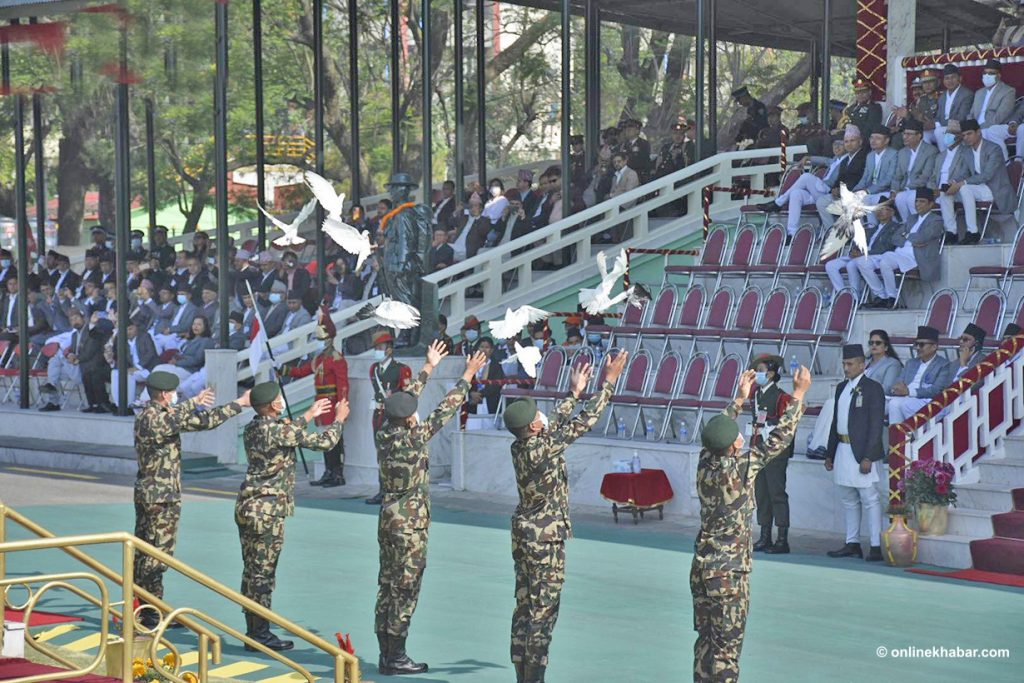
A special ceremony is being held today at the Sainik Manch at Tundikhel. The Nepal Army fired a cannon salute earlier this morning to mark the occasion. The President, Prime Minister, and other dignitaries are expected to attend the ceremony, which the President will address.
PM Balen to attend but not address
In previous years, it was customary for the Prime Minister to deliver an address at the Republic Day ceremony, even when the President was present. However, this year Prime Minister Balen Shah will not be delivering a speech.
He had written a letter to Sheetal Niwas, requesting that the President, as the symbol of the republic, address the gathering in his place.
The Prime Minister’s Secretariat confirmed that the Prime Minister will attend the Tundikhel ceremony but will not address it.
Historical background
On February 1, 2005, King Gyanendra seized direct control of the government. In response, the seven agitating political parties and the then-armed CPN (Maoist) reached a 12-point agreement to restore full democracy. By November 2005, political forces that had been divided into three camps converged into two, giving fresh momentum to the movement.
On May 18, 2006, the reinstated parliament passed a resolution curtailing royal authority and suspending the monarchy, a document often referred to as Nepal’s “Magna Carta.” It also resolved to bring the Maoists into the peace process and hold a Constituent Assembly election.
On April 10, 2008, the first Constituent Assembly election was held.
Although the first Constituent Assembly could not promulgate a constitution, it accomplished a great deal. A second Constituent Assembly, elected on November 19, 2013, promulgated the Constitution of the Federal Democratic Republic of Nepal on September 20, 2015. Elections at all three tiers of government were subsequently held, bringing the constitutionally mandated federal, provincial, and local governments into operation.
The Constituent Assembly declared Ram Baran Yadav as the first President of Republican Nepal. Bidhya Devi Bhandari became the second President and the first woman head of state following the promulgation of the new constitution. The current President is Ram Chandra Paudel, Nepal’s third President. Before the republic, Nepal was a monarchy with the king as head of state.