
Kathmandu, September 3
Rain falls steadily over the grounds of Tribhuvan University Teaching Hospital. People hurry in and out, some looking for shelter, others speaking urgently into their phones.
But there is another sound beneath the rain — a silence that seems to settle over the crowd and refuse to leave.
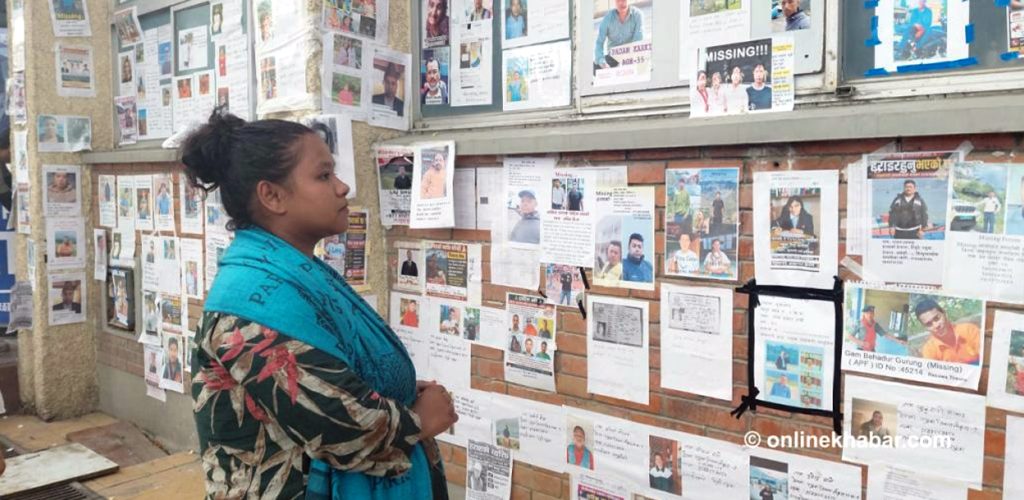
Along the hospital walls are dozens of photographs. They are faces of sons and daughters, husbands and wives, brothers and sisters, parents and children.
The people who put them there never imagined they would one day have to search for their loved ones this way. They do not know where those smiling faces are now, or even whether they are still alive.
Sabina KC stands in front of the photographs, scanning them one by one.
Her eyes linger on each face, moving from one photograph to the next, as though she might suddenly hear a familiar voice calling her name.
It has been eight days since her husband, Sohit BK, disappeared. Her 23-year-old brother-in-law, Amar BK, and their uncle, Narayan BK, are missing too. Three members of the same family have vanished.
And Sabina has only one thing left to hold on to: the possibility that they are still alive.
That is why she is here, looking at photographs on a hospital wall, searching for the faces she knows.
There is little family support around her now. Her mother-in-law is abroad. So is the wife of her missing brother-in-law. Sabina is left to wait, worry and search for answers herself.
Three days after Sohit disappeared without a word, she left her infant with a neighbour and came looking for him. She has another child, five years old, who suffers from seizures and sometimes loses consciousness. That child, too, is being cared for by a neighbour while Sabina moves from one place to another trying to find out what happened to her husband.
As she speaks, her eyes fill with tears. Her fingers tremble. She looks back at the photographs. Then towards the hospital entrance as an ambulance pulls in.
She has been doing this for days — looking, waiting, asking.
‘My husband and uncle ran towards the forest’
The BK family is originally from Surkhet. They had gone to Syabrubesi for work, while Sabina and Sohit lived with their family in a rented room in Imadol. Sohit worked as a driver, transporting goods from China.
On August 26, at around 6 am, Sohit and his uncle Narayan left together. They had barely reached Ronga when the flood came.
Three other people nearby began running for their lives.
One of them survived and eventually reached the area above Syabrubesi. He later told Sabina that he had seen Sohit and Narayan running towards the forest as the flood approached.
“Your husband and uncle ran towards the forest,” he told her. “I saw them running as the flood was coming.”
Those few words have become the foundation of Sabina’s hope.
She keeps wondering what might have happened after they disappeared from sight.
Are they somewhere in that forest? Are they hungry? Are they thirsty? Are they still waiting to be found?
Her brother-in-law Amar had been travelling from Timure in a vehicle. While coming from the Tatopani hill area, he made his final phone call to an elder brother.
“I have reached the checkpoint,” he said.
That was the last anyone heard from him.
‘They won’t let us go’
The account that Sohit and Narayan ran towards the forest has given Sabina a reason to believe they may still be alive. It has also left her frustrated by what she sees as the limits of the search.
She says search teams and helicopters have reached the tunnel and Timure, but that the forest where her husband and uncle are believed to have fled has not been searched.
“The forest where my husband Sohit and Narayan are said to have run has not been searched,” she says. “Neither drones nor helicopters have reached there. The family has not been allowed to go and search either. There has to be a search.”
Her relatives have tried to arrange a helicopter after speaking with the Army. Nothing has come of it. The family was also told that one of them would be taken there by helicopter. That did not happen either.
Sabina has asked to go herself. But she says she has been told she cannot.
“Even when I say I will go myself, whether they are dead or alive, they say I am not allowed to go,” she says.
She returns again and again to the same point.
“There has to be a search,” she says. “Even someone who is alive can die because of the government’s negligence.”
For Sabina, eight days of uncertainty have become a battle against time. She believes the search in the upper reaches has not been urgent enough and fears that every day without a proper search could reduce the chances of finding those who may still be alive.
A photograph on the wall, but no single list to follow

The photographs at Teaching Hospital have only made her more restless.
Her sisters came on Sunday and put up the photographs of the missing family members.
By then, Sabina had already spent days waiting for news.
“What is the point of staying in the room and crying all day?” she says. “I would rather search for my husband myself.”
She has called the police toll-free number, 100. She has used her TikTok account to circulate information about the disappearance. She has filed a missing-person report at the Imadol police post and contacted emergency numbers.
But another part of the process has left her frustrated: she says she has had to provide the same information repeatedly.
“Wherever I go, they write down the name again,” she says.
For her, the problem is simple. Once the name of a missing person is registered, it should be available to everyone involved in the search.
“Once it is registered, the name should be in the system,” she says. “We should not have to go somewhere else and register the same name again.”
For families waiting for missing loved ones, however, repeating a name is far more than an administrative inconvenience. It means telling the story of the disappearance all over again, taking out the photograph once more and hearing yet again that the person they are searching for has not been found. With every repetition comes the painful possibility that hope may slowly give way to despair.
That is why Sabina wants a properly managed central list of missing people—one that can be accessed and updated by all the agencies involved in the search.
Still, her most urgent demand is not about paperwork. It is about going into the places where she believes her husband and uncle may still be waiting.
“The government has to go into the forests and gorges in the upper areas,” she says. “It is not enough to search only where vehicles can reach or where there are tunnels. The government has to reach everywhere.”
She folds her hands as she makes one final appeal.
“I hope this reaches the government. They have to reach there, even if it means sending drones or helicopters. If the government cannot go, let the family go.”
Then comes the sentence that sums up the desperation of the past eight days:
“Otherwise, I will go myself to search for my husband.”