

There was no bad shot. No dropped catch. No tactical mistake. There was not even a toss.
Nepal’s Asian Games campaign ended without its quarterfinal against Sri Lanka producing a single ball of cricket. Persistent rain washed out the match, and Sri Lanka advanced to the semifinal because it held the higher ICC T20I ranking.
For Nepal, that meant the work done to reach the quarterfinal suddenly counted for little.
Nepal had beaten Afghanistan in the group stage and finished top of Group A. It had earned its place in the knockout stage on the field. But once the quarterfinal was abandoned, the tournament’s playing conditions turned to a different measure — ranking.
That is not a new feature of Asian Games cricket. It was already visible at the 2023 Hangzhou Asian Games.
When the final was decided by a ranking
India and Afghanistan were playing for gold in the men’s cricket final. Afghanistan had reached 112 for five after 18.2 overs when rain stopped play.
The match never resumed.
Instead of the bat and ball deciding the gold medal, the ICC T20I rankings came into play. India, the higher-ranked side, was declared the winner. Afghanistan, despite reaching the final and putting itself in a position to compete for gold, took silver.
The same pattern appeared elsewhere in Hangzhou.
In the women’s quarterfinal, India had scored 173 in 15 overs against Malaysia, which had faced only two balls before rain intervened. India progressed to the semifinal on the basis of its higher ranking.
The Pakistan-Indonesia and Bangladesh-Hong Kong quarterfinals were also abandoned because of rain. Pakistan and Bangladesh advanced because they were higher ranked.
So what happened to Nepal in 2026 was not an isolated incident. It was the continuation of a system already seen at the previous Asian Games.
The same rule, a different tournament
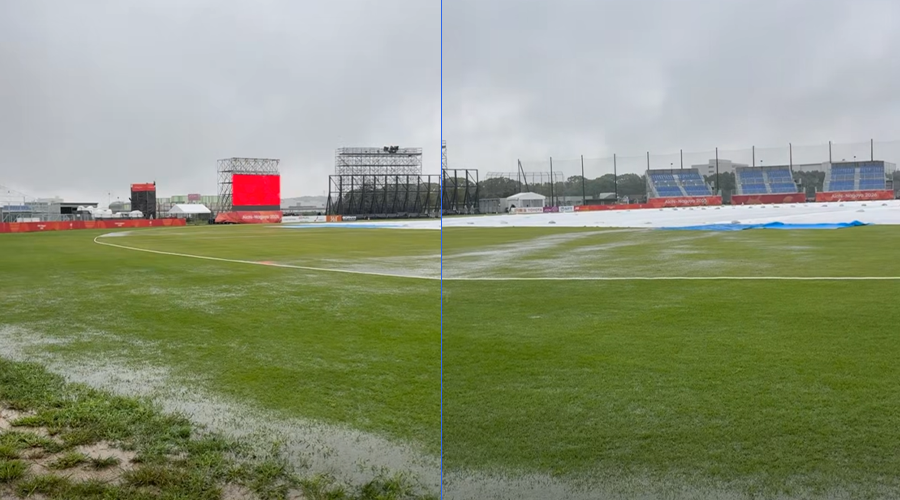
This time the setting was Japan.
In the women’s competition, China and Bangladesh never even reached the toss in their quarterfinal. The match was abandoned because of rain, and Bangladesh progressed because it was higher in the women’s T20I rankings.
Then came the men’s quarterfinals.
India, Pakistan, Sri Lanka and Bangladesh had been placed directly into the quarterfinals based on their ICC T20I rankings. Nepal, Afghanistan, Japan, Hong Kong, Malaysia and Oman had to play the preliminary stage for the remaining four quarterfinal places.
Once those teams reached the knockout stage, however, the ranking advantage did not disappear.
The Asian Games cricket playing conditions contain a specific provision for this situation. Under Rule 16.10.2(b), if a knockout match is completely abandoned because of rain and no result is possible, the higher-ranked team is declared the winner and advances.
That rule allowed India to progress without playing Afghanistan and Pakistan to advance without playing Hong Kong. And then Nepal’s quarterfinal met the same fate.
The paradox for teams outside the top rankings
This is where the structure becomes difficult to ignore.
Nepal had to play its way into the quarterfinal. So did the other teams competing for the four available places.
The higher-ranked teams, meanwhile, entered the competition at the quarterfinal stage.
That in itself is a tournament-format decision based on ranking.
But the same ranking can become decisive again when rain prevents a knockout match from being played.
For a team such as Nepal, that creates a narrow path.
It must first earn its way through the competition on the field. Then, once it reaches the knockout stage, it can still lose the opportunity to compete if weather prevents the match from taking place.
Nepal’s group-stage performance could not overcome Sri Lanka’s higher ranking once the quarterfinal was abandoned.
The same happened to Malaysia against Bangladesh.
The rule therefore does not affect only associate nations. Higher-ranked full members benefit from it as well. India, Pakistan, Sri Lanka and Bangladesh all progressed from rain-affected quarterfinals without completing those matches.
But the consequences are particularly significant for teams that spend much of their cricket outside the higher reaches of the rankings.
A rainout does not give them the chance to show what they can do against a higher-ranked opponent.
Who made this rule?
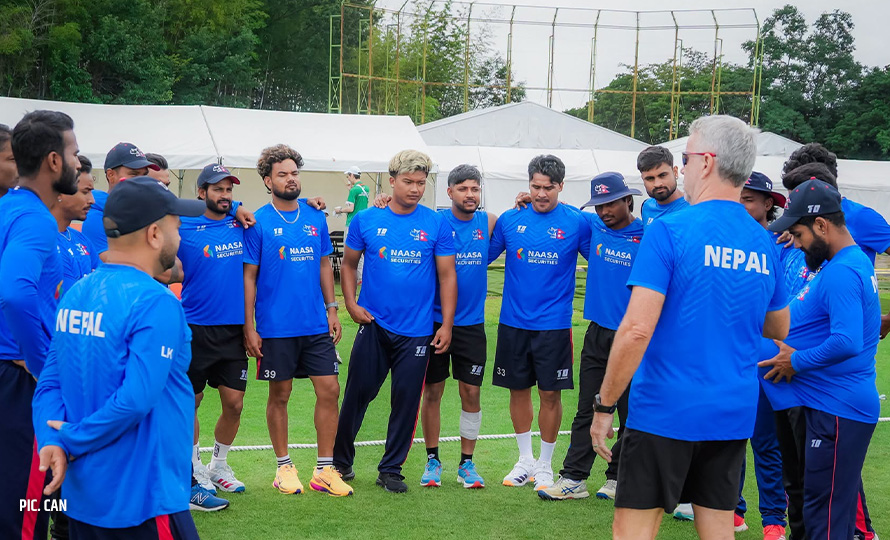
That leads to another question: whose rule is it?
The Asian Games are governed by the Olympic Council of Asia. Cricket at the Games operates within the competition regulations established for the event.
The ICC can provide advice and recommendations on cricket-related matters, but the final decision on the Asian Games playing conditions rests with the OCA.
The available official material shows that the 2026 men’s tournament structure was built around ICC T20I rankings. India, Pakistan, Bangladesh and Sri Lanka were given direct quarterfinal places on that basis.
The ICC’s description of the tournament structure also explained that those four teams would enter at the quarterfinal stage while the remaining teams competed for the other places.
What is less clear is whether the ICC specifically advised that abandoned knockout matches should be decided by ranking.
There is therefore an important distinction.
The ICC rankings are clearly being used as part of the Asian Games structure. But there is not enough publicly available official evidence to conclude that the ICC itself instructed the Asian Games to use the ranking as the winner-determining rule for rain-abandoned knockout matches.
Why use the rankings at all?
There is a practical reason. The Asian Games are not a standalone cricket tournament. Cricket has to fit into a much larger multi-sport schedule.
In the 2026 men’s competition, the quarterfinals were scheduled for September 28 and 29, the semifinals for October 1, and the gold and bronze medal matches for October 3.
That leaves little room for a series of reserve days.
If one quarterfinal is postponed, another match cannot simply be pushed back indefinitely without affecting the rest of the tournament.
So a competition needs a predetermined way of deciding who advances when a knockout match cannot be played.
In this tournament, that mechanism is the T20I ranking.
It is clear. It is known to the teams before the match. And it allows the schedule to continue.
But clarity does not remove the competitive question.
A rule problem, or a structural problem?
The ranking rule is straightforward on paper.
If rain completely prevents a knockout match and there is no result, the higher-ranked team advances.
The difficulty is what that rule means in practice.
For Nepal, the journey to the quarterfinal required performances on the field. The team beat Afghanistan and topped its group.
But in the quarterfinal, there was no opportunity to repeat that performance.
The outcome was determined before Nepal and Sri Lanka could compete.
That raises a broader question about the balance between tournament practicality and sporting opportunity.
There is also the question of infrastructure.
Japan is highly developed in many areas, but cricket remains an emerging sport there. The facilities available for cricket are not necessarily comparable with those found in countries where the sport has a much deeper infrastructure.
In the matches affected by rain, there was no provision to completely cover the playing surface. Once the rain arrived and the ground became wet, the possibility of restarting the match became even more difficult.
That means the problem cannot be reduced simply to whether the ranking rule is fair or unfair.
The tournament format, the limited schedule, the playing conditions and the infrastructure all intersect.
When the weather becomes part of the competition
There is an unavoidable irony in what happened to Nepal.
A team can beat a higher-ranked opponent in the group stage, finish first in its group and reach the knockout stage. But if rain prevents the next match from taking place, the earlier performance may no longer be enough.
The ranking, established before the tournament, can suddenly become more important than what happens during the tournament itself.
That may be an efficient way to keep a multi-sport event on schedule.
But it also means that, in a knockout competition, sometimes the decisive moment does not happen with a bat or ball in hand.
For Nepal, it happened when the rain came. And there was nothing left to play.