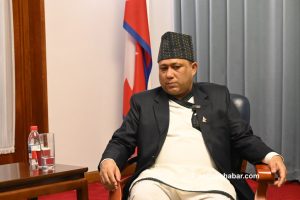


For Mahendra Chaulagain, Qatar was never supposed to become home.
In 1996, he arrived in the Gulf country as an ordinary worker, driven by little more than the need to support a struggling family back in Jhapa.
He had no grand business plan. His elder brother was already in Qatar, and Mahendra followed him in the hope that two incomes would be enough to keep the family afloat.
Twenty-eight years later, the man who once arrived in Qatar as a worker runs a company employing between 1,500 and 2,000 people. More than half of them are Nepali workers.
He is now known as a businessman, social campaigner and prominent representative of the Nepali community in Qatar.
But his journey from a worker to a business owner did not happen overnight.
It began with an office-boy job, followed by work as a salesman, nearly seven years as a migrant worker, and eventually a small Nepali bookstore in Doha.
Today, Chaulagain owns 100 percent of the company he started expanding years ago—something he says is difficult to achieve for an older company with Qatari shareholders.
Behind that success, he credits three things: struggle, honesty and discipline.
From Jhapa to Qatar
Mahendra Chaulagain was born into a modest family in Barhadashi-7 of Jhapa, formerly Dangibari-3.
There were three brothers in the family, and money was scarce.
His elder brother had already gone to Qatar. Mahendra followed in 1996, hoping the two brothers could earn enough to support their family.
“We were three brothers and our financial situation was difficult,” he says. “My elder brother had already gone to Qatar. I went so that, with both of us earning, we could support the family.”
Qatar was very different then.
Nepalis were still few and far between. Coming across another Nepali could feel almost like being back home.
Over time, however, the Nepali community grew.
Chaulagain spent nearly seven years working as a labourer. Then he began thinking about what came next. He wanted to build something of his own.
A bookstore becomes a business
His first jobs in Qatar were modest. He worked as an office boy and later as a salesman. Then, in 2003, he opened what he describes as Doha’s first Nepali bookstore.
He called it Everest Book Shop.
The shop quickly became more than a place to buy books.
For Nepalis looking for newspapers, novels and other Nepali literature, it became a meeting point—a place where people could find not only reading material from home but also one another.
“I opened the first Nepali bookstore in Doha selling Nepali newspapers and novels,” he says. “There was no such shop in Doha, so it became a meeting place for many Nepalis. I used to bring newspapers and books from Nepal and sell them.”
Running the bookstore also exposed him to other possibilities.
In 2005, he established Woodland Import-Export Company and entered the clothing business, importing garments from Nepal, China and Dubai and selling them in Qatar.
Five years later, in 2010, he changed the company’s name to Woodland Contracting and General Services and moved into construction.
He started by employing 28 workers.
Today, the company employs between 1,500 and 2,000 people, more than 70 percent of them Nepali.
From worker to 100 percent owner

As the business grew, Mahendra Chaulagain began expanding further. One of his biggest milestones came only recently.
Foreigners owning companies outright in Qatar has not always been straightforward, particularly in older companies where Qatari nationals hold shares.
Chaulagain says he recently succeeded in bringing the entire ownership of Woodland Contracting and General Services under his control.
“I received full ownership of my company only a few months ago,” he says. “I believe I am probably the first Nepali businessman to have obtained 100 percent ownership of an existing company in this way.”
The company, which he has operated for the past 14 years, has a capital of 500,000 Qatari riyals.
He owns 90 percent of the shares, while his wife, Kanchan Chaulagain, owns the remaining 10 percent.
For Chaulagain, the achievement is not simply a business milestone. He sees it as evidence that his years of hard work and integrity earned the trust of the Qatari authorities.
“When Qatar saw that I was capable, it trusted me and gave me full ownership of the company,” he says.
‘It wasn’t luck. It was hard work’
Mahendra Chaulagain does not attribute his success to luck.
He points instead to the values that have guided him since his days as a worker: hard work, honesty and discipline.
“It wasn’t luck. It was hard work,” he says. “When I think that someone who left with 600 rupees now pays 200,000 riyals in rent, even I find it astonishing.”
His experience as a worker has also shaped the way he treats his employees.
He says he does not believe in being harsh with workers because he once stood where they do.
“I treat workers like family. I am someone who came through the same path,” he says.
For years, he worked within Qatar’s strict legal and competitive business environment. He believes his consistency and honesty eventually earned him the confidence of the authorities.
“When I left for Qatar, I was pushed by poverty and hardship at home,” he says. “I thought I would work for a few years and return. I never imagined I would establish my own company and come this far.”
Business became a platform for social work

As his business grew, Mahendra Chaulagain increasingly turned his attention towards the Nepali community.
He helped bring Nepali businessmen in Qatar together and established the Nepal Business Association, Qatar, becoming its founding president.
He claims it was the first Nepali organisation registered with the Qatari government.
Under his leadership, the association sent significant assistance to Nepal during the earthquake, floods and Covid-19 pandemic.
During the coronavirus pandemic alone, it sent oxygen cylinders worth more than Rs 10 million to Nepal.
More recently, Chaulagain was elected president of the International Jhapa Society, having previously served as its senior vice-president.
“We want to unite Jhapa residents around the world and contribute to the development of the district,” he says.
He has also served as an adviser to NRNA Qatar and as an honorary member of the NRNA ICC.
Qatar became a second home
For many Nepalis, Qatar is a place of work.
For Mahendra Chaulagain, it has become something closer to a second home.
He has spent much of his adult life on its roads, in its neighbourhoods and along its coast. His children grew up there and are now nearing the end of their education.
Yet his attachment to Nepal has never disappeared.
He increasingly feels the pull to return home, invest more in Nepal, create jobs and contribute to the country.
“I have never had to look back in my life,” he says. “Time took me along the path of success. I never imagined I would reach this point.”
He credits his parents’ blessings for much of what he has achieved.
“I am satisfied with what I have achieved through my hard work,” he says.
‘Qatar is a country built with Nepali sweat’
Mahendra Chaulagain believes the relationship between Qatar and Nepal should not end with Nepalis working there and sending money home.
Thousands of Nepalis have helped build Qatar, and millions of young Nepalis continue to work there.
He believes the skills, experience and capital accumulated in Qatar should eventually contribute to Nepal’s development.
“Qatar is a country that we Nepalis built with our sweat,” he says. “Now Nepal also needs to understand the value of that sweat.”
Under his leadership, the Nepal Business Association, Qatar, has worked with the Nepal Exporters Association to promote trade and business between the two countries.
But Chaulagain is critical of Nepal’s slow and complicated administrative processes.
“Qatar has a one-stop system. In Nepal, you have to visit 10 different offices,” he says. “If Nepal wants to attract foreign investment, the government must be stable and investment-friendly.”
A life-threatening illness changed his priorities
A few years ago, Mahendra Chaulagain faced a serious health crisis.
He spent a long period in hospital, caught between life and death.
“My life has had many ups and downs. This is my second life,” he says.
He remained unconscious in hospital for a long time.
“By God’s grace and because of my good deeds, I was brought back into society with renewed energy,” he says. “Life is like water on a taro leaf. I survived because of God’s grace and my family’s love.”
The experience changed his priorities.
He decided to devote the rest of his life to social service and nation-building.
Frustrated by Nepal’s slow system
His desire to contribute to Nepal is accompanied by frustration with the country’s bureaucracy.
“Opening a company in Qatar takes an hour. In Nepal, going from the ward office to the ministry can take six months,” he says.
He says investors coming to Nepal can become discouraged even at the airport.
He believes Nepal needs a toll-gate system and greater government-to-government cooperation to attract investment.
“Qatar’s roads and towers were built through toll-gate systems,” he says. “Nepal would not lose if it allowed roads to be built on 20- or 30-year leases.”
He is also concerned about frequent changes of ambassadors at the Nepali embassy in Qatar.
He says more than 10 ambassadors have changed since 1999 and believes an ambassador should serve for at least four years to ensure policy continuity.
The Nepali community in Qatar has also changed significantly during his years there.
Nepalis were once largely identified as labourers. Today, he says, thousands of Nepalis are involved in restaurants, salons, building materials, manpower supply and other businesses.
He believes Nepal needs to create an environment where the money earned by migrant workers in the Middle East can be invested productively at home.
“We are ready to help,” he says. “But the government needs a clear vision.”
Family and the road ahead
His wife, Kanchan Chaulagain, is a co-shareholder in his company.
Their son Durga and daughter Kamaksha are completing their education in Qatar.
Chaulagain plans to bring his children back to Nepal after they finish their studies.
He already has investments in Nepal, including a hotel, a school and a rice mill, and wants to expand them further.
He says he never imagined reaching the position he occupies today.
His explanation for the journey is simple.
“Those who have big dreams can turn difficulties into opportunities,” he says. “I am living proof that even someone who goes abroad to work can eventually become a leader.”
For Chaulagain, the formula remains unchanged: honesty, discipline and continuous hard work.