Kathmandu, August 7
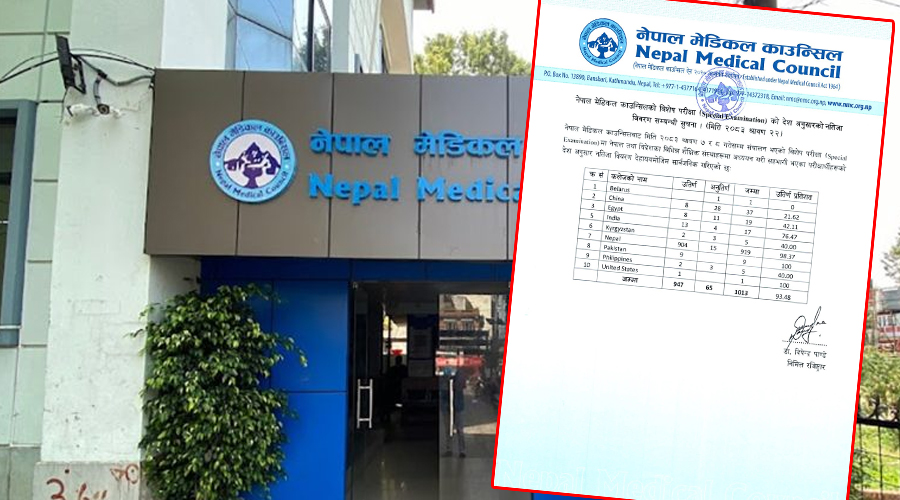
A higher number of medical graduates from foreign institutions failed the Nepal Medical Council’s Special Licensing Examination compared to graduates from Nepali medical colleges. The Nepal Medical Council (NMC) has published country-wise results of the Special Examination conducted on July 23 and 24 (Shrawan 7 and 8). A total of 1,013 candidates who studied at medical institutions in Nepal and abroad appeared for the examination.
According to a notice issued on August 7 by Acting Registrar Dr Dipendra Pandey, 947 candidates (93.48 per cent) passed the examination, while 65 failed. Among the 919 candidates who graduated from Nepali medical institutions, only 15 failed the exam. Among graduates from foreign institutions, candidates who studied in India performed comparatively better. Of the 17 candidates from India, 13 (76.47 per cent) passed.
In contrast, only eight out of 37 candidates (21.62 per cent) who studied in China passed, while 28 failed. Among those who studied in Egypt, eight of the 19 candidates (42.11 per cent) passed. Two out of five candidates each from Kyrgyzstan and the Philippines passed, giving both countries a 40 per cent pass rate.
All nine candidates who graduated from Pakistan passed the examination. The sole candidate from the United States also passed, while the only candidate from Belarus failed. Medical graduates in Nepal are required to pass the Nepal Medical Council’s licensing examination before they are allowed to practice medicine. The council conducts the licensing examination twice a year.
Acting Registrar Dr Dipendra Pandey said the results of the Special Examination should not be used to conclude that doctors educated in Nepal are better than those trained abroad. According to him, the council published the country-wise results solely to disclose the examination outcomes and not to assess the quality of medical education in any country or institution.
“This is only the result of one examination. It cannot be used to conclude that medical education in Nepal is superior or that education abroad is inferior,” Dr Pandey said. He added that the examination results will also be forwarded to the Medical Education Commission, which is responsible for conducting a detailed analysis, evaluating the quality of medical education, and making any necessary policy decisions. “We have published the results for administrative transparency. It is the responsibility of the Medical Education Commission to analyse the overall findings and draw conclusions about the quality of medical education,” Dr Pandey said.