

Kathmandu, November 5
The festive atmosphere of Tihar, Nepal’s second-largest festival, has spread across cities and villages. In the Kathmandu Valley, major commercial centres such as New Road, Ason, Indra Chowk, Bhotahiti, Baneshwor, Koteshwor, Lagankhel and Thimi have seen increasing numbers of shoppers buying festival essentials.
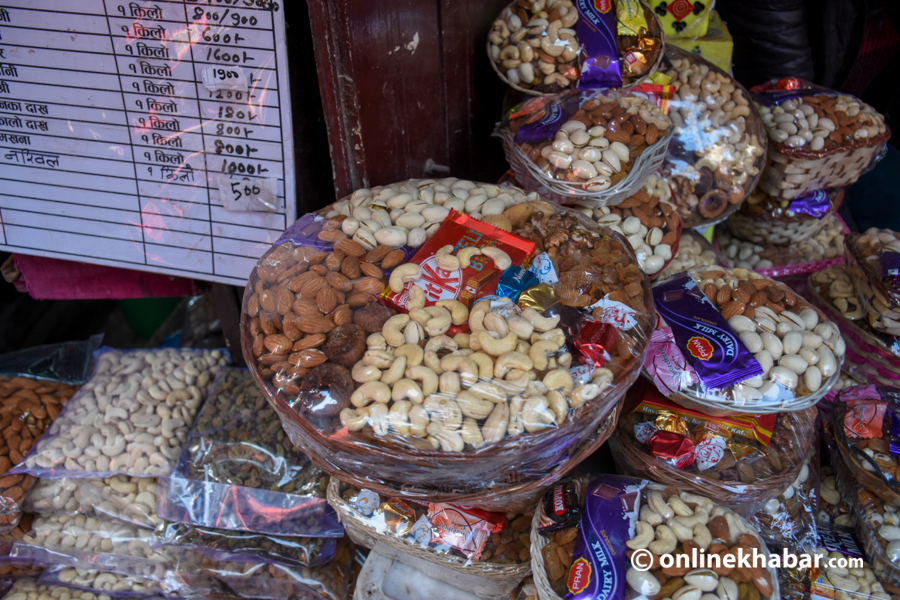
During Tihar, sisters traditionally apply seven-coloured tika to their brothers and offer them marigold garlands and Bhai Masala (dry fruits) as gifts. As a result, demand for dry fruits, which are consumed less frequently at other times of the year, rises sharply during Tihar.
Although shops displaying cashews, coconuts, dates, cloves, almonds, raisins, walnuts, rock sugar, makhana, cinnamon, cardamom and figs are crowded with customers, many consumers have been taken aback by the prices this year.
With Tihar already underway, Bhai Masala prices in the market have become prohibitively expensive. Prices of some dry fruits have doubled compared to last year.
Pistachio prices double; almonds and walnuts also become more expensive
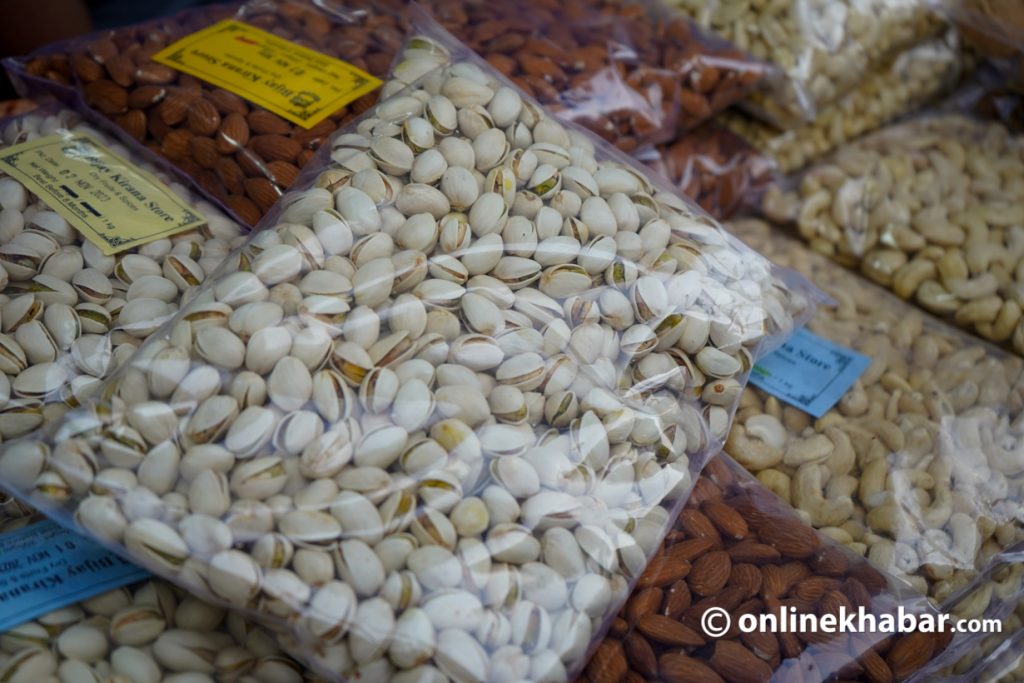
Consumers visiting markets to purchase Bhai Masala this year have been particularly shocked by the price of pistachios. According to Bachchan Sah, owner of Masala Bhandar, a wholesale shop in New Baneshwor, prices of pistachios, almonds, walnuts and other dry fruits have risen sharply compared to last year.
Sah said pistachios have recorded the highest price increase this year. Their price has risen from Rs 2,000 per kg last year to more than Rs 4,000 this year.
“Pistachios cost Rs 2,000 last year, but the price has now increased to Rs 4,000,” he said.
Similarly, the prices of almonds and walnuts have also put a strain on consumers’ budgets. Almonds, which cost Rs 1,500-1,600 per kg last year, are now priced at Rs 1,800 per kg. Walnuts, which were available at Rs 500 per kg, now cost Rs 600-650.
Sah said the price of cardamom had also increased from Rs 7,000 per kg last year to as much as Rs 8,000 this year.
Cashews have also become expensive, costing Rs 2,000-2,200 per kg. According to him, makhana are currently priced at Rs 2,000 per kg in the market.
Coconuts are being sold at Rs 1,000 per kg and raisins at Rs 500-600 per kg in the wholesale market.
Consumers are purchasing packaged or loose Bhai Masala according to their budgets, but the overall cost of Tihar shopping has increased considerably.
Why have Bhai Masala prices increased?
Traders say the main reasons behind the increase in wholesale prices of dry fruits are disruptions along import routes, delays at customs points and the impact of international market prices. With goods from China unable to reach the market due to disruptions along the route, traders have been forced to depend on the Indian market.
“Prices are already high internationally due to reasons such as wars. On top of that, the route through China is disrupted, and goods are not arriving from there. So we are currently bringing goods from Khari Baoli in Delhi,” he said.
With wholesale prices rising, prices in the retail market become even higher. Consumers are routinely forced to pay steep prices during festivals. During Tihar last year, too, dry fruit prices had increased by Rs 50-300.
The Nepal Retail Trade Association, an umbrella organisation of retail traders, has repeatedly accused wholesale traders of failing to provide retail traders with proper prices and bills for dry fruits such as cashews and almonds.
Retail traders claim that they cannot sell products to consumers at lower prices because wholesalers themselves are selling them at high rates.
Department of Commerce unaware of price monitoring, says inspection team will be deployed
The Department of Commerce, Supplies and Consumer Protection, which is responsible for monitoring and regulating the market, has shown little concern about the issue.
Consumers have complained that some traders are charging arbitrary prices, citing disruptions along the route through China and higher prices of goods imported from India. However, the department has admitted that it has not yet conducted any market monitoring of Bhai Masala prices.
Anil Kiran, information officer at the department, said its attention was currently focused only on cooking oil and sweets. Responding to a question about the sharp increase in dry fruit prices, he said the department had not been able to look into the matter.
“We have not monitored dry fruit prices,” he told Onlinekhabar. “We are currently monitoring cooking oil and sweets.”
He said inspection teams would also be deployed to monitor dry fruit prices starting Thursday.
Complaints about black marketing and unreasonable price hikes in the market during festivals emerge every year. However, as regulatory bodies fail to take timely action, consumers are forced to pay inflated prices and risk being cheated.
Although the department has assured consumers that it will deploy inspection teams tomorrow, most consumers have already completed their Tihar shopping at the higher prices.
Bhai Masala worth nearly Rs 920 million imported in October alone
While concerns over shortages and high prices continue in the market, Department of Customs data show that a large quantity of dry fruits was imported in October alone, ahead of Dashain and Tihar.
An analysis of the Department of Customs’ data for the current fiscal year 2083/84 shows that dry fruits used in Bhai Masala, including cashews, almonds, walnuts and coconuts, worth Rs 918.55 million, were imported in October alone. The total quantity stood at 5,672,921 kg.
Traders imported these goods from countries including China, the United States, India and Vietnam ahead of the festival season.
In terms of value, walnuts accounted for the largest share of dry fruit imports in October. A total of 857,768 kg of shelled and unshelled walnuts were imported during the month, for which Nepal paid Rs 355.032 million.
The largest share of walnuts, amounting to 738,500 kg, came from China, while 119,000 kg were imported from the United States.
In terms of quantity, however, coconuts were the most imported dry fruit in Nepal. A total of 4,467,265 kg of coconuts were imported in October alone, with a total import value of Rs 240.41 million.
According to the data, almost 100 per cent of the coconuts imported into Nepal come from India.
Imports of cashews, another expensive dry fruit in high demand during Tihar, were also substantial. In October alone, Nepal imported 213,189 kg of cashews worth Rs 205.885 million.
Vietnam overtook India as the largest supplier of cashews to Nepal this year. A total of 120,134 kg of cashews were imported from Vietnam, compared to just 92,853 kg from India.
Almond imports were also significant. Nepal imported 105,598 kg of almonds worth Rs 98.583 million in one month, with the United States serving as the main source of supply. Of the total quantity, 104,487 kg came from the United States alone.
In addition, Nepal imported 26,537 kg of figs worth Rs 17 million from India in October alone, along with 1,384 kg of pistachios worth Rs 1.457 million from various countries.
While customs data indicate that substantial quantities of Bhai Masala have entered the market, traders are charging exorbitant prices, citing disruptions along import routes and delays in the arrival of goods.