
Nepal has been part of the Asian Games journey since the inaugural edition in New Delhi in 1951. Seventy-five years later, the country is preparing for its 20th appearance at Asia’s biggest multi-sport event, still chasing a first gold medal.
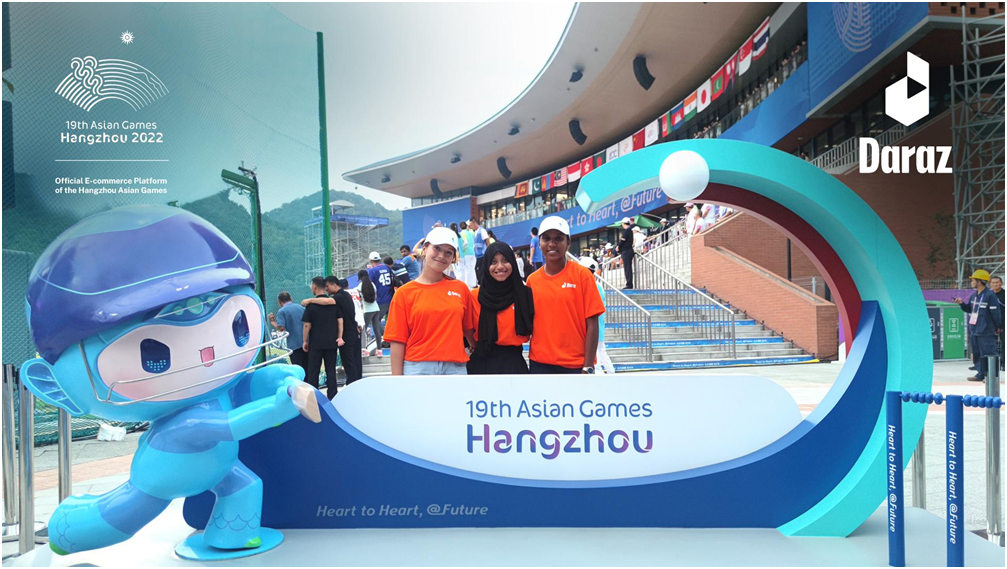
From the first Asian Games in 1951 to the 19th edition in Hangzhou, China, in 2023, Nepal has competed in 17 editions. The country missed the 1954 and 1962 Games but has otherwise maintained a regular presence at the continental event.
Yet despite its long association with the Asian Games, Nepal’s medal tally remains modest: three silver and 23 bronze medals. No Nepali athlete has won an Asian Games gold medal.
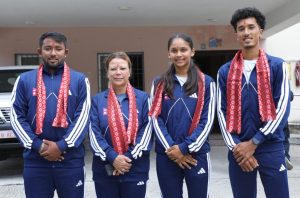
Nepal is now preparing for the 20th Asian Games in Aichi-Nagoya, Japan, scheduled for September 19 to October 4. The country plans to send 137 athletes across 22 sports.
The Aichi-Nagoya Games are expected to bring together more than 11,000 athletes from 45 countries, competing in 43 sports, 71 disciplines and 469 events.
35 years for the first medal
When Nepal first competed at the Asian Games, athletics was the only sport it entered.
But the country had to wait 35 years for its first medal.
Nepal participated in seven of the first nine editions without winning a medal. The wait finally ended at the 1986 Asian Games in Seoul, South Korea.
Taekwondo player Bidhan Lama won Nepal’s first medal, while the country went on to claim an impressive eight bronze medals in that edition — four in taekwondo and four in boxing.
Dal Bahadur Rana Magar, Manoj Bahadur Shrestha, Sushil Pokharel and Tul Bahadur Thapa won bronze medals in boxing.
In taekwondo, Bidhan Lama, Raj Kumar Budhathoki, Raj Kumar Rai and Ram Bahadur Gharti Chhetri won bronze.
Seoul remains Nepal’s most successful Asian Games edition in terms of the number of medals won.
Four years later, Nepal won just one medal at the 1990 Beijing Asian Games, with boxer Chitra Bahadur Gurung taking bronze.
At the 1994 Hiroshima Games in Japan, Nepal won two bronze medals — through taekwondo player Man Bahadur Shahi and karateka Sita Rai.
Sabita’s historic silver
After winning only bronze medals in three consecutive editions, Nepal finally claimed its first silver at the 1998 Asian Games in Bangkok.
Taekwondo player Sabita Rajbhandari became the first Nepali athlete to win a silver medal at the Asian Games, nearly five decades after Nepal’s first participation.
Her silver remains one of the biggest individual achievements in Nepal’s Asian Games history and the highest medal Nepal has won in taekwondo at the Games.
Nepal also won three bronze medals in Bangkok. Taekwondo players Kishor Shrestha and Sapana Malla won bronze, while Sambhar Bahadur Gole added another bronze in karate.
The success of taekwondo continued at the following Games.
At Busan in 2002, Deepak Bista, Renuka Magar and Ritu Jimmy Rai won bronze medals in taekwondo.
At the 2006 Doha Asian Games, Nepal again won three bronze medals in taekwondo. Deepak Bista claimed another medal, becoming the first Nepali athlete to win medals at two consecutive Asian Games. That record still stands.
From Nepal’s strongest sport to a medal drought
Taekwondo has been Nepal’s most successful sport at the Asian Games.
Of Nepal’s 26 medals, 14 have come from taekwondo — one silver and 13 bronze.
After beginning its medal run in 1986, taekwondo continued to deliver at almost every Asian Games through 2006, with the exception of the 1990 edition.
Nepal won four taekwondo bronze medals in 1986, one in 1994, one silver and two bronze in 1998, and three bronze medals each in 2002 and 2006.
But that golden period eventually came to an end.
Nepali taekwondo has failed to win a medal in the last four Asian Games. The generation that followed Deepak Bista has yet to reproduce the medal-winning run of the past.
A sport that once became synonymous with Nepal’s international sporting identity is now facing questions about its decline.
Medal numbers also began to fall
Nepal’s strongest period at the Asian Games came between 1996 and 2006. Except for the 1990 edition, the country won more than one medal in each edition during that period.
Over roughly two decades, Nepal collected 21 medals, including one silver, mainly through taekwondo, boxing and karate.
After 2006, however, Nepal’s medal count began to decline.
At the 2010 Guangzhou Asian Games, boxer Deepak Maharjan won Nepal’s only medal — a bronze.
Four years later in Incheon, karateka Bimala Tamang won bronze in kata.
Nepal returned to the silver-medal podium at the 2018 Asian Games in Jakarta and Palembang, where the men’s team cross-country paragliding team won silver.
Bijay Gautam, Bimal Adhikari, Sushil Gurung, Yukesh Gurung and Bishal Thapa finished second, just 27 points behind Japan.
It was Nepal’s first silver medal in two decades, although it remained the country’s only medal in that edition.
Arika brings new hope
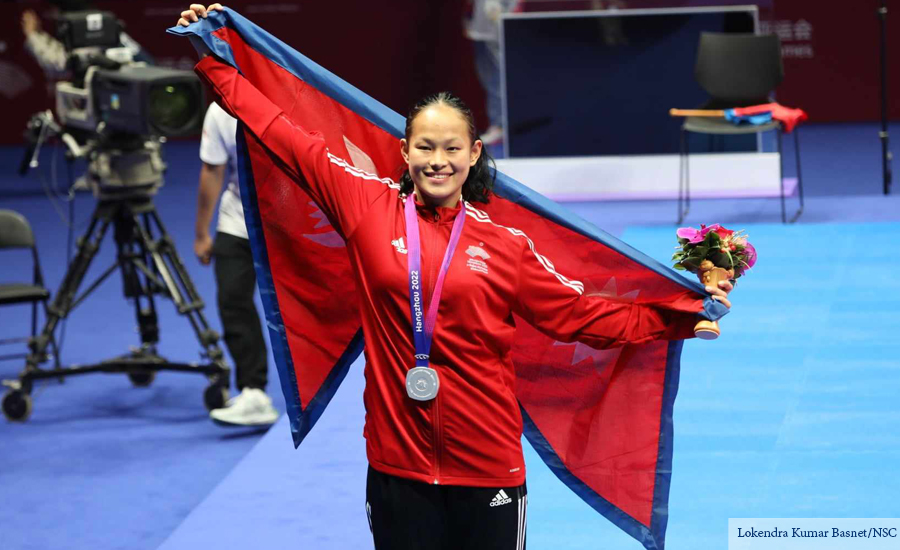
Nepal’s medal tally improved at the 19th Asian Games in Hangzhou, where the country won one silver and one bronze.
Karateka Arika Gurung won silver in the women’s kumite over-68kg category, while Nepal’s women’s kabaddi team won bronze in its first Asian Games appearance.
Arika became the first Nepali athlete since Sabita Rajbhandari in 1998 to win an individual silver medal at the Asian Games.
Her achievement also made her the third Nepali athlete or team to win an Asian Games silver, after Rajbhandari and Nepal’s paragliding team.
The women’s kabaddi team’s bronze was equally significant. The two medals meant Nepal had won more than one medal at a single Asian Games for the first time in 17 years.
75 years of participation, but gold remains elusive
Arika’s run in Hangzhou also offered Nepal a glimpse of what had long seemed out of reach.
She reached the final of the women’s over-68kg kumite but lost to Kazakhstan’s Sofia Berultseva.
For Arika, the silver was less about what she had won and more about the gold she had missed.
Her performance nevertheless raised a familiar question: When will Nepal finally win an Asian Games gold?
Nepal has now competed in 17 editions of the Asian Games over 75 years. It has won 26 medals but none of them gold.
The absence of gold is particularly striking because several Asian countries with comparatively smaller sporting resources than Nepal have already produced Asian Games champions.
After the Hangzhou Games, the National Sports Council launched the ‘Mission 2026’ campaign with the target of winning gold and reaching double figures in the medal tally at the Aichi-Nagoya Games. Athletes from 10 sports were initially included in the programme.
This time, Nepal is competing in 22 sports with 137 athletes.
But questions remain over whether Nepal has adequately identified its strongest medal prospects and prepared them accordingly. Training, international exposure, investment and preparation have all become part of the debate as the country pursues its first Asian Games gold.
Arika Gurung, who won silver in Hangzhou, is naturally among Nepal’s leading medal hopes. Nepal is also looking towards other martial arts disciplines and the women’s kabaddi team.
Whether those hopes can finally translate into gold — and whether Nepal can significantly improve its overall medal tally — will be decided when competition begins in Aichi-Nagoya on September 19.
After 75 years of participation, Nepal’s biggest Asian Games question remains unanswered: when will the country’s first gold finally arrive?