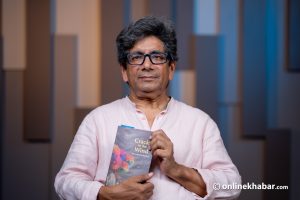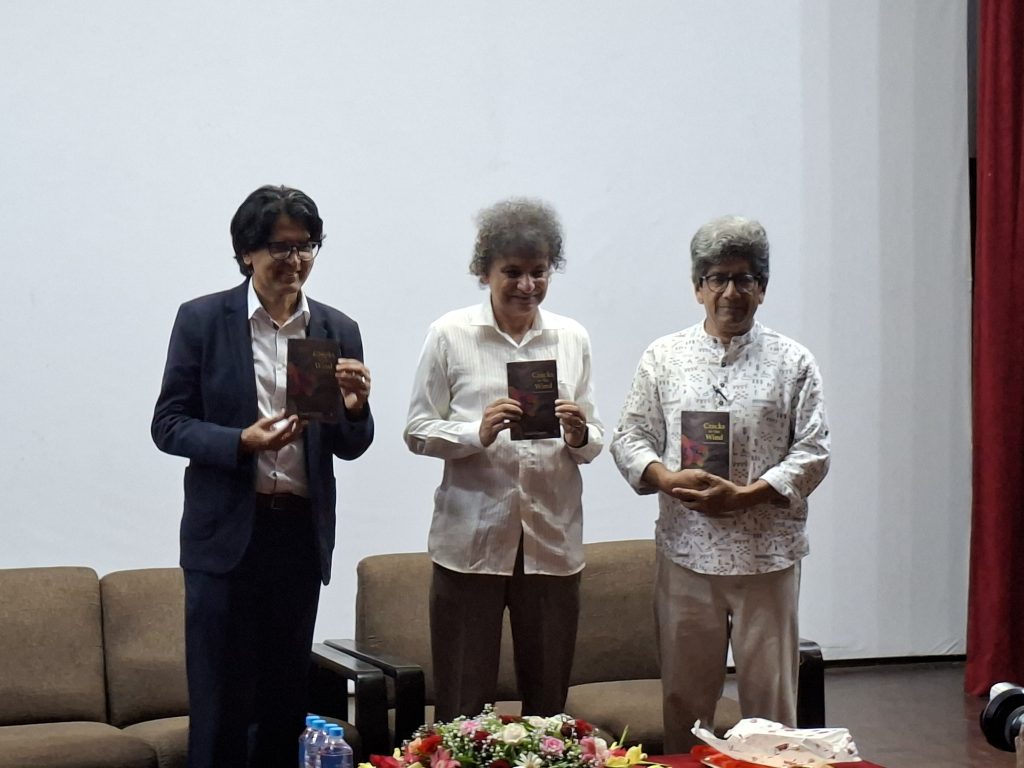
Professor and Author Arun Gupto’s long-awaited book, Cracks in the Wind: Memoirs from Lumbini, was officially launched on Sunday. The event featured in-depth reflections by guest speaker Professor/Author Bishnu Sapkota, alongside an intimate conversation between the author and his lifelong friend, Professor/Author Sanjeev Uprety.
A “decades-in-the-making” autofiction memoir
Speaking at the launch, Professor Bishnu Sapkota characterised Cracks in the Wind as a powerful, paradigm-shifting entry into Nepali biographical literature. He described the book as a beautifully crafted autobiographical fiction, or “autofiction memoir,” that shifts the focus away from traditional mainstream autobiographies.
“Mainstream autobiographies talk about what I am,” Sapkota says, referencing the self-indulgent nature of typical bureaucratic or political memoirs. “On the contrary, Cracks in the Wind is about who I am, why I am… It is not about the Arun Gupto we meet at the university; it is about the sources that made him.”
Sapkota playfully dubbed the book “The Arun Gupta Code,” comparing its intricate personal history to the layered mysteries of a Dan Brown novel, The Da Vinci Code. He emphasised that the book serves as a “personal gift” to those who know Gupto privately, and a stunning, standalone work of art for the general public.
Elevating the margins: Subaltern heroes
A defining feature of the book, according to Sapkota, is its portrayal of its characters, including figures like Sukhi, Bimala, Khema, Uma, and most notably, Rahmat.
Sapkota praised Gupta’s literary restraint and ethical sensitivity in portraying the characters who inhabit the deepest margins of society. He noted that the author deliberately avoids presenting them as figures who deserve the reader’s pity or sympathy. Instead, Gupta portrays them as complex and dignified individuals whose lives possess their own agency and power.
Describing them as “subaltern heroes,” Sapkota said these characters emerge as the true heroes of Gupta’s childhood, not merely as people on the periphery but as artists, poets, storytellers and influential figures who helped shape his imagination and worldview.
He further observed that the book beautifully captures cultural and religious diversity through the intimate relationships among its characters, presenting a tender picture of coexistence across faiths, communities and social backgrounds.
According to Sapkota, Cracks in the Wind ultimately becomes a story of harmony between different cultures and religions, as well as between humans, nature, animals and the mysteries that surround everyday life.
Behind the code: A 25-year-old secret
Reflecting on why he was chosen to speak at the launch, Sapkota shared a nostalgic anecdote from 2001 when they went on a Tribhuvan University departmental trip to Butwal.
During that trip, Gupto and Sapkota snuck away on a motorcycle to visit Bahadurganj. It was there that Sapkota personally met Rahmat, the very character who anchors the historical, sociological, and familial warmth of the book.
Sapkota revealed that Gupto had already conceived the book back then, intending since childhood to document the lives of Rahmat and his peers.
“It is a book long in the making. Decades in the making,” Sapkota said.
Never-concluding conversations
Sapkota noted that Gupto possesses a unique persona that “inevitably mystifies the mundane,” transforming ordinary day-to-day interactions into philosophical reflections.
“Every conversation with him over these 32 years has never concluded,” Sapkota said. “Every conversation has demanded a new one, and that new one has demanded another.”
Drawing on a scientific analogy regarding memory and the brain’s neural networks, Sapkota concluded that Cracks in the Wind represents those stubborn, unyielding “synapses of childhood memories” that refuse to be erased by time, serving as a profound map of self-reflection and artistic discovery.
The author’s appeal
Taking the stage, Professor Arun Gupto expressed profound vulnerability regarding his transition from academic writing to literary fiction, noting that Cracks in the Wind represents his very first creative venture. He detailed the rigorous process and dedication required to mould his childhood memories into a novelistic framework.
This is my first creative venture. I have worked very hard,” Gupto confessed to the audience.
“I have listened to the advisors; my professor, Shreedhar Lohani. Before I was almost finishing the novel, he gave me some novels, to see how to read it with a certain sensibility. So, it’s a tremendous amount of hard work which has gone into it.”
Emphasising that the true completion of a book lies in its reception, Gupto asked the audience for their honest critiques rather than mere praise. He noted that academic and public responses are crucial for fueling the country’s wider literary environment.
“I would really request you and seek your blessings regarding how you read this book. Your responses are very important for me,” Gupto said. “If you read this book and come up with some comments and responses, that will be wonderful, not only for me, but for the whole of our reading culture and academia.”