
Kathmandu, November 19
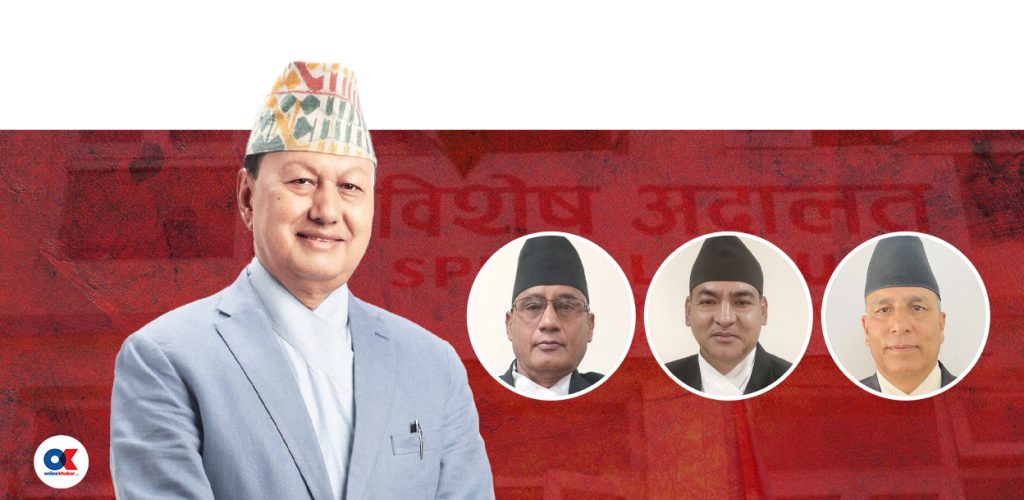
The Special Court has acquitted former Information and Communications Minister Mohan Bahadur Basnet, who introduced the proposal to procure TERAMOCS technology, while convicting three former board members of the Nepal Telecommunications Authority (NTA) for advancing the procurement process.
The verdict has raised questions over the court’s reasoning, particularly because the minister who initiated the process was cleared while the officials responsible for implementing the decision were found guilty.
The case, one of the most widely discussed corruption scandals involving the telecommunications sector, was filed against 18 individuals and companies, with the Commission for the Investigation of Abuse of Authority (CIAA) seeking recovery of Rs 3.21 billion in damages.
According to the full text of the verdict, recently made public, the Special Court found three former NTA board members guilty and sentenced them to imprisonment and fines. However, it did not establish how much financial loss their decisions had caused the state.
The verdict was delivered by a bench comprising Special Court judges Hemant Rawal, Dilliratna Shrestha and Umesh Koirala.
‘No ministerial interference established’
The legal provision allows the information and communications minister to approve the NTA’s annual policy and programme. In practice, ministers generally approve the programme submitted by the authority without making changes.
On September 8, 2017, the NTA submitted its annual policy and programme for the fiscal year 2017/18 to then minister Mohan Bahadur Basnet. Basnet added a sentence to the proposal before approving it.
The added provision stated that the authority would operate appropriate equipment and systems to monitor international calls and control Voice over Internet Protocol (VoIP), commonly known as call bypass.
That decision became the basis for the NTA to move ahead with the procurement of TERAMOCS technology.
Following the minister’s decision, the authority proceeded with plans to purchase equipment and software for the system. The process later became the subject of the high-profile TERAMOCS corruption case.
The CIAA had accused Basnet of deliberately inserting a provision serving his own interests into the authority’s programme, arguing that the decision could compromise the privacy of Nepali citizens by enabling monitoring of their personal communications.
The Special Court, however, considered the submission of the NTA’s proposed programme to the minister and his approval of it to be a normal administrative process.
In its verdict, the court said there was no evidence that the minister had specifically directed the procurement of TERAMOCS or interfered in the subsequent process.
It stated that Basnet’s involvement in the procurement process beyond the initial policy-level decision had not been established.
The court observed: “After the policy directive issued by this defendant, the programme was approved by the authority and the procurement process began. However, the fact that this defendant was involved in any other stage of the procurement process has not been established.”
The CIAA, meanwhile, had argued that Basnet made the decision to include TERAMOCS procurement in the programme without conducting any study.
The authority, an autonomous regulatory body, was directed to include a system for international call monitoring and VoIP control as part of its annual programme.
The court interpreted the minister’s decision as the inclusion of a policy-level programme before the procurement process had formally begun. It also questioned why the CIAA had investigated and filed a case over the TERAMOCS decision without examining other similar decisions made by the minister.
The process initiated by Basnet eventually developed into a controversial procurement exercise. However, the court reasoned that he had not specifically instructed the authority to purchase the TERAMOCS system, procure it at a particular price or select a particular company through a particular method.
It concluded that there was no evidence of criminal intent.
“The prosecution has also failed to present objective evidence that these defendants obtained personal benefits from the procurement process,” the verdict states. “In these circumstances, there is no basis to conclude that this defendant was involved in the procurement process related to the case.”
‘The law should have been in place first’
The CIAA had accused then NTA chairman Digambar Jha of attempting to implement TERAMOCS without the necessary legal framework.
A study conducted before the procurement decision had concluded that monitoring citizens’ calls and data consumption would be possible only after the relevant law was enacted.
The study had warned that purchasing the technology without first establishing a legal framework could violate citizens’ right to privacy. The Special Court’s verdict, however, does not appear to address that study or its findings.
The CIAA had also argued that Basnet exceeded his authority by adding the provision to the NTA’s annual programme. According to the charge sheet, he had made several decisions in his capacity as minister by exercising powers that belonged to the Cabinet. The TERAMOCS procurement decision was among them.
The Special Court, however, treated the minister’s decision as a policy-level inclusion made before the procurement process began.
It held that Basnet had not instructed the authority to purchase the system itself, specified the procurement price or directed it to award the contract to a particular company.
‘The board was responsible’
The Special Court convicted former NTA chairman Digambar Jha and board members Dhanraj Gyawali and Tika Prasad Upreti, sentencing each to six months in prison and imposing a fine of Rs 50,000.
Jha received an additional six-month prison sentence for committing corruption while holding a special-class government position.
The court found the three guilty for deciding to proceed directly with procurement without first completing the necessary groundwork, including a feasibility study, procurement master plan, detailed project report, cost estimate and benefit analysis.
In effect, the court acquitted former minister Basnet, who had introduced the proposal and made the initial decision, but held the NTA board members responsible for implementing it.
The court reasoned that although the minister had issued a directive, it was the responsibility of the autonomous authority’s board, led by its chairman, to ensure that the procurement process followed the required procedures.
The verdict states: “By disregarding all these aspects and directly specifying the system and instructing the management to proceed, these defendants placed the officials involved in the procurement process in a position where they were compelled to initiate procurement according to the specified system.”
Another group of defendants acquitted
Although the Special Court concluded that irregularities had occurred in the procurement process and that the state had suffered losses, it did not determine the amount of loss attributable to the actions of the three officials it convicted.
As a result, the court imposed prison sentences and fines but did not specify any amount as damages to be recovered from them.
The court also acquitted Purushottam Khanal, who became NTA chairman after Jha’s tenure, despite the CIAA’s allegation that he had played a role in advancing the procurement process.
Khanal had overseen much of the procurement work. The CIAA had accused him of failing to use the electronic government procurement system and of adopting a service-procurement procedure when the transaction should have followed the process for purchasing goods.
During his tenure, expensive equipment had been imported into Nepal through customs. Questions over procurement and payments eventually led to corruption charges against both Jha and Khanal.
Khanal was also accused of arranging for a commission agent to facilitate commission payments to Lebanon-based contractor Ventrayz Solutions, which had not even established a branch office in Nepal.
However, the Special Court did not examine in depth the questions raised over the quality and suitability of the TERAMOCS equipment.
Instead, it formed a three-member expert team to inspect the equipment. The team concluded that the equipment and materials, except for the issues specifically noted in its report, were functional. The court relied on the report while acquitting the defendants.
Buyers convicted, contractor acquitted
After the corruption case was filed, the Special Court ordered an inspection of the equipment and formed a three-member expert team comprising Dr Sanjiv Prasad Pandey, associate professor at the Institute of Engineering, Pulchowk; Roza Kiran Basukala, deputy director at the NTA; and Inspector Anand Niraula of the Central Investigation Bureau of Nepal Police.
The inclusion of an NTA official in the inspection team itself raised questions about a potential conflict of interest, given that the CIAA had accused the authority of corruption. Nevertheless, the team submitted a report stating that the equipment was functional, and the report appears to have become a key basis for the acquittals.
According to the experts, 132 devices known as V-Probes were required for Nepal Telecom and 302 for Ncell to monitor calls. However, the NTA had procured only 109 such devices.
Technical experts had argued that the authority’s flawed design could result in an additional financial burden of at least around Rs 2 billion. The CIAA had also relied on their technical assessments while pursuing the corruption case.
The Special Court did not delve into the substance of those allegations.
The three-member bench stated in its full verdict: “Unless it is clearly demonstrated that an action caused loss or damage, describing such an action as corruption would be contrary to judicial values, norms and principles of judicial practice.”
The court also acquitted the contractor company, its directors and its Nepal representative, despite the allegation that they had benefited from the financial losses suffered by the state.
The verdict examined the roles of former NTA chairman Purushottam Khanal and authority officials including Achyutananda Mishra and Surendralal Hada, among others.
The court held that the equipment and materials supplied by Lebanon-based Vanrise Solutions matched the required specifications and therefore ruled that the company could not be held liable for the claimed damages.
It also granted acquittal to the defendants as the procurement process had been advanced in implementation of a Supreme Court order, according to the verdict.
The Special Court delivered its verdict in the TERAMOCS case on July 6, 2026. The full text was made public recently.